
Oil Falls More Than 5% This Week: What Lower Crude Prices Mean for African Economies
Brent crude fell more than 5% this week, creating contrasting consequences across Africa. Oil-producing economies face pressure on government revenues and foreign exchange, while importing countries could benefit from lower fuel and transport costs.
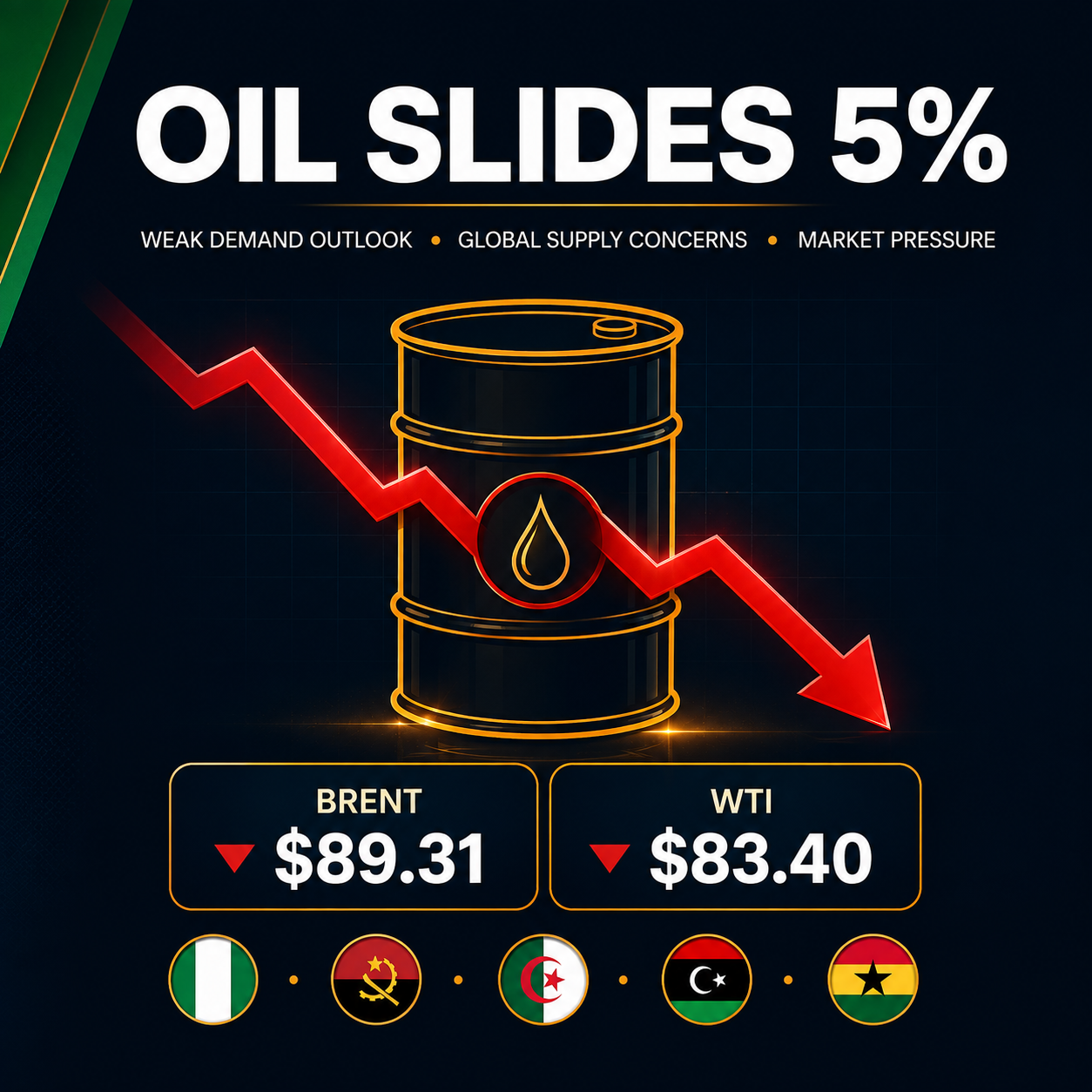
Global oil markets closed the week under pressure, with Brent crude settling at $89.31 per barrel — down 0.43% on Friday and more than 5% for the week — while WTI slipped to $83.40, down 0.16% on Friday and more than 4% for the week.
The decline reflects several overlapping forces, including shifting expectations around U.S. interest rates following comments at the Jackson Hole gathering, ongoing uncertainty surrounding the Strait of Hormuz, speculation about possible negotiations affecting major shipping routes, developments involving Venezuelan oil supply and persistent geopolitical risk across the Middle East.
For Africa, however, a drop of this size is never a single story.
It creates two very different economic outcomes at the same time.
Oil-producing countries face pressure on export revenues and government finances, while oil-importing economies could benefit from lower energy and transportation costs.
Oil Producers Face Revenue Pressure
Africa's major oil-producing economies — including Nigeria, Angola, Algeria, Libya and Ghana — remain heavily dependent on crude exports.
Oil revenue plays a central role in government budgets, foreign-exchange earnings and broader economic stability across many of these countries.
A sustained decline in global crude prices can therefore create immediate challenges.
Lower prices mean that every barrel exported generates less revenue. Over time, this can reduce government income, weaken foreign-exchange inflows and place additional pressure on currencies.
For governments that built their annual budgets around higher oil-price assumptions, a prolonged period of weaker crude prices could force difficult adjustments.
The Fiscal Challenge
Lower oil prices can affect African producer economies in several ways:
Reduced government revenue from oil exports
Lower foreign-exchange earnings
Pressure on currency reserves
Increased budget deficits
Reduced fiscal space for public spending
Greater pressure on borrowing requirements
The longer Brent remains below previous price assumptions, the more difficult these challenges can become.
For countries already managing high debt levels or limited foreign-exchange reserves, the impact could be particularly significant.
Nigeria Remains Highly Sensitive to Oil Prices
Nigeria is one of the African economies most exposed to changes in global oil markets.
Despite ongoing efforts to diversify the economy, crude exports remain central to government revenue and foreign-exchange earnings.
A sustained decline in oil prices could therefore complicate Nigeria's broader macroeconomic outlook.
The shift comes at an important moment for the country's energy sector, as investors closely watch developments surrounding Dangote Refinery, domestic crude supply reforms and wider changes across Nigeria's petroleum industry.
Lower global oil prices could affect government revenues at the same time policymakers are attempting to strengthen investment and improve the efficiency of the energy sector.
For Nigeria, the direction of crude prices will remain closely linked to:
Government revenue
Foreign-exchange availability
Naira stability
Fiscal planning
Energy-sector investment
Oil Importers Could Benefit
The story is very different for African countries that depend heavily on imported petroleum products.
Lower crude prices can reduce the cost of importing fuel and, eventually, help lower domestic fuel and transportation costs.
That can provide an important economic benefit.
Cheaper energy reduces costs across the wider economy. Transport companies may face lower operating expenses, businesses can experience reduced logistics costs and households may benefit from lower fuel prices.
Lower Oil Prices Could Ease Inflation
Energy costs affect almost every part of the economy.
When fuel becomes cheaper, transportation costs can fall. That can eventually reduce the cost of moving food, manufactured goods and other essential products.
For oil-importing African economies, lower crude prices could therefore help ease inflationary pressure.
Potential benefits include:
Lower fuel-import costs
Reduced transportation expenses
Lower inflationary pressure
Improved household purchasing power
Reduced operating costs for businesses
The extent of these benefits will depend on domestic fuel taxes, subsidies, exchange rates and how quickly global price changes are passed through to consumers.
The $90 Brent Level Is Now a Key Threshold
The most important question is whether the latest decline represents a temporary market correction or the beginning of a more sustained pullback.
Brent crude has now moved below the $90 per barrel level, placing increased attention on the outlook for September.
If prices remain below that threshold, African governments may begin reassessing assumptions used in their revenue forecasts and budget planning.
For oil-producing economies, the focus will be on protecting government revenues and foreign-exchange reserves.
For importing economies, policymakers will be watching whether lower global prices translate into reduced domestic fuel and inflation costs.
The Fed Adds Another Layer of Pressure
Oil prices are not the only challenge African economies are watching.
Changing expectations around U.S. monetary policy could also affect frontier and emerging-market currencies.
A more hawkish Federal Reserve can strengthen the U.S. dollar and increase pressure on currencies in developing markets.
For African economies, this creates a potentially difficult combination.
Oil-producing countries could face lower export revenues while simultaneously dealing with currency pressure.
For oil-importing countries, lower crude prices may provide some relief, but a weaker domestic currency could increase the local cost of purchasing oil priced in U.S. dollars.
That means the ultimate impact of lower global oil prices will vary significantly from country to country.
Temporary Dip or a Bigger Oil Market Shift?
The coming weeks will determine whether this week's decline was simply a short-term reaction to geopolitical developments and shifting market expectations.
Several factors will remain important:
Geopolitical Risk
Developments across the Middle East and around key shipping routes could quickly affect global oil supply expectations.
Venezuelan Supply
Changes in Venezuelan production and exports could influence the balance between global supply and demand.
U.S. Interest Rates
Expectations surrounding Federal Reserve policy will continue influencing the U.S. dollar, global investment flows and commodity markets.
Global Demand
The outlook for economic growth in major economies will remain critical for future oil demand.
What African Economies Should Watch Next
For Africa, the direction of oil prices will remain one of the most important economic stories heading into September.
The impact will not be uniform.
Oil producers will be watching government revenues, foreign-exchange earnings and currency stability.
Oil importers will be watching fuel costs, inflation and consumer spending.
If Brent remains below $90 per barrel, expect renewed discussions among African finance ministries about revenue forecasts, fuel subsidies and currency stability.
The next phase of the oil market could therefore have significant consequences for government budgets and households across the continent.
Market Pulse Africa will continue tracking how the latest oil-price movement filters through to producer economies and consumer markets across Africa.