Dangote Refinery's $5bn IPO: The Crude Supply Problem Investors Are Watching
Dangote Refinery is targeting a landmark $5 billion IPO, potentially making it Africa's largest-ever stock market listing. But as investors assess the opportunity, the refinery's reliance on imported crude remains a critical issue for margins and valuation.
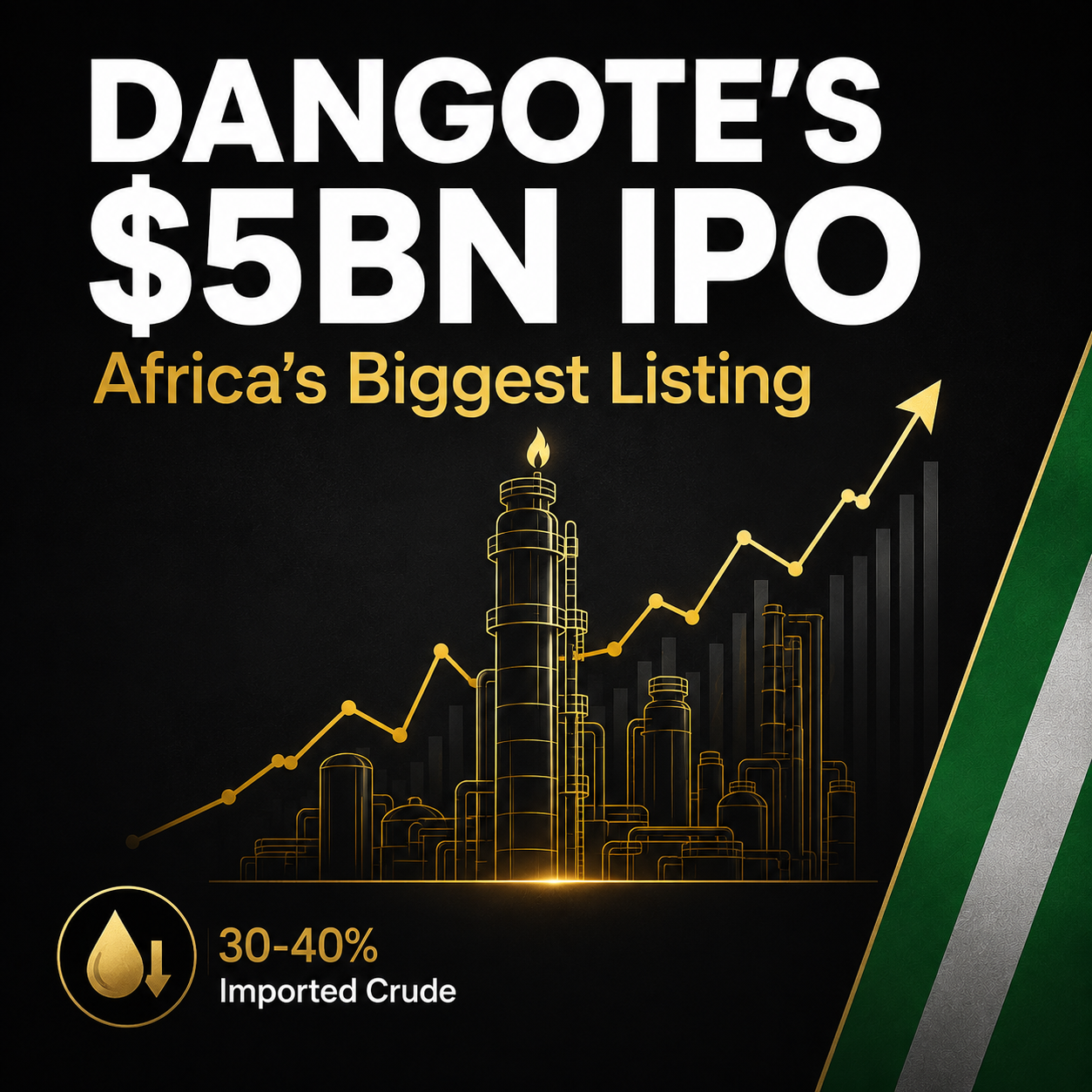
Dangote Refinery is moving closer to what could become Africa's largest-ever stock market listing, with the company reportedly targeting around $5 billion in proceeds ahead of a planned October 2026 debut on the Nigerian Exchange.
For a project of this scale — one of the world's largest single-train refineries — the IPO would represent a major milestone for Nigerian industry and African capital markets.
But investors considering the opportunity are increasingly focused on a structural question that could have significant implications for the refinery's future profitability:
Where does the crude actually come from?
A Landmark IPO for African Markets
A successful listing would put Dangote Refinery among the most significant corporate transactions in African financial market history.
The refinery has demonstrated production capacity at levels approaching 700,000 barrels per day, positioning it as a major force in Nigeria's downstream petroleum industry and potentially reshaping refined-product flows across Africa.
The investment case is clear in principle. Nigeria is one of Africa's largest crude oil producers, while the continent remains heavily dependent on imported refined petroleum products.
Dangote Refinery was designed to help change that equation.
However, the economics of the refinery depend heavily on securing reliable and competitively priced crude oil.
The Imported Crude Challenge
Despite operating in one of Africa's largest oil-producing countries, an estimated 30–40% of Dangote Refinery's crude intake has reportedly been imported rather than sourced domestically.
That creates an important question for potential IPO investors.
Why does a refinery located in Nigeria need to import such a significant share of its crude supply?
The answer lies in several structural challenges within Nigeria's oil industry.
Existing Export Commitments
Many Nigerian crude producers already have established commercial arrangements with international buyers.
Long-standing contracts and export relationships can make it difficult to redirect significant volumes toward domestic refiners, even when local processing capacity is available.
Oil-Backed Loan Obligations
Another challenge involves oil-backed financing arrangements.
Some crude production has already been committed to purchasers or lenders under agreements linked to financing obligations. These commitments can limit the volumes immediately available to domestic buyers.
Logistics and Supply Infrastructure
Physical logistics also remain a major factor.
Producing crude oil and efficiently delivering it to a refinery are not always the same thing. Infrastructure constraints, transportation arrangements and supply-chain coordination can all affect the ability of domestic producers to supply local refining facilities.
As a result, Dangote Refinery may sometimes find imported crude commercially necessary despite Nigeria's substantial domestic oil production.
Why Crude Supply Matters for Investors
For investors evaluating a potential $5 billion IPO, crude sourcing is more than an operational detail.
It could directly influence profitability.
Importing crude can introduce additional transportation costs, supply-chain risks and exposure to international market dynamics. A refinery with greater access to competitively priced domestic crude could potentially operate with stronger and more predictable margins.
That makes the future structure of Nigeria's domestic crude market particularly important.
If Dangote Refinery can secure a larger share of its crude requirements locally, the economics of the business could improve significantly.
Government Reforms Could Change the Picture
Nigeria's government is reportedly considering reforms aimed at making it easier for domestic crude producers to supply local refineries directly.
Such reforms could potentially reduce the barriers currently separating Nigerian crude production from Nigerian refining capacity.
For Dangote Refinery, this could mean:
Greater access to domestic crude supplies
Lower dependence on imported crude
Reduced transportation and supply-chain costs
More predictable refinery input economics
Potentially stronger operating margins
However, the reforms have not yet been finalized.
Their implementation timeline — particularly in relation to the planned IPO — remains one of the major issues investors will be watching.
The Key Question: Before or After the IPO?
The timing could prove crucial.
If meaningful improvements in domestic crude supply arrangements occur before shares begin trading, investors may see a stronger and clearer long-term profitability outlook.
If the refinery remains heavily dependent on imported crude for an extended period, margins could remain under pressure.
That creates a relatively straightforward investment equation:
Better domestic crude access could strengthen Dangote Refinery's investment case and support a higher valuation.
Continued dependence on imported crude could limit margins and place pressure on the company's valuation ceiling.
A Defining African Corporate Story
Dangote Refinery's planned IPO is expected to be one of the defining African corporate stories of 2026.
The potential listing represents more than a fundraising event. It will also test investor confidence in Nigeria's industrial transformation, domestic energy infrastructure and the ability of African capital markets to support companies operating at global scale.
The headline figure may be $5 billion, but the details behind the valuation could matter even more.
For investors, crude supply will remain one of the most important numbers to watch.
Market Pulse Africa will continue tracking the reform timeline, domestic crude-sourcing data, refinery operations and IPO pricing details as they develop.