Evans Kongnyuy and the Rise of Data Analysis Training in Cameroon
Since 2023, Evans Kongnyuy has trained more than 50 students in data analysis and supported over 100 students with research, academic writing and mentorship, combining statistical tools with emerging AI technologies.
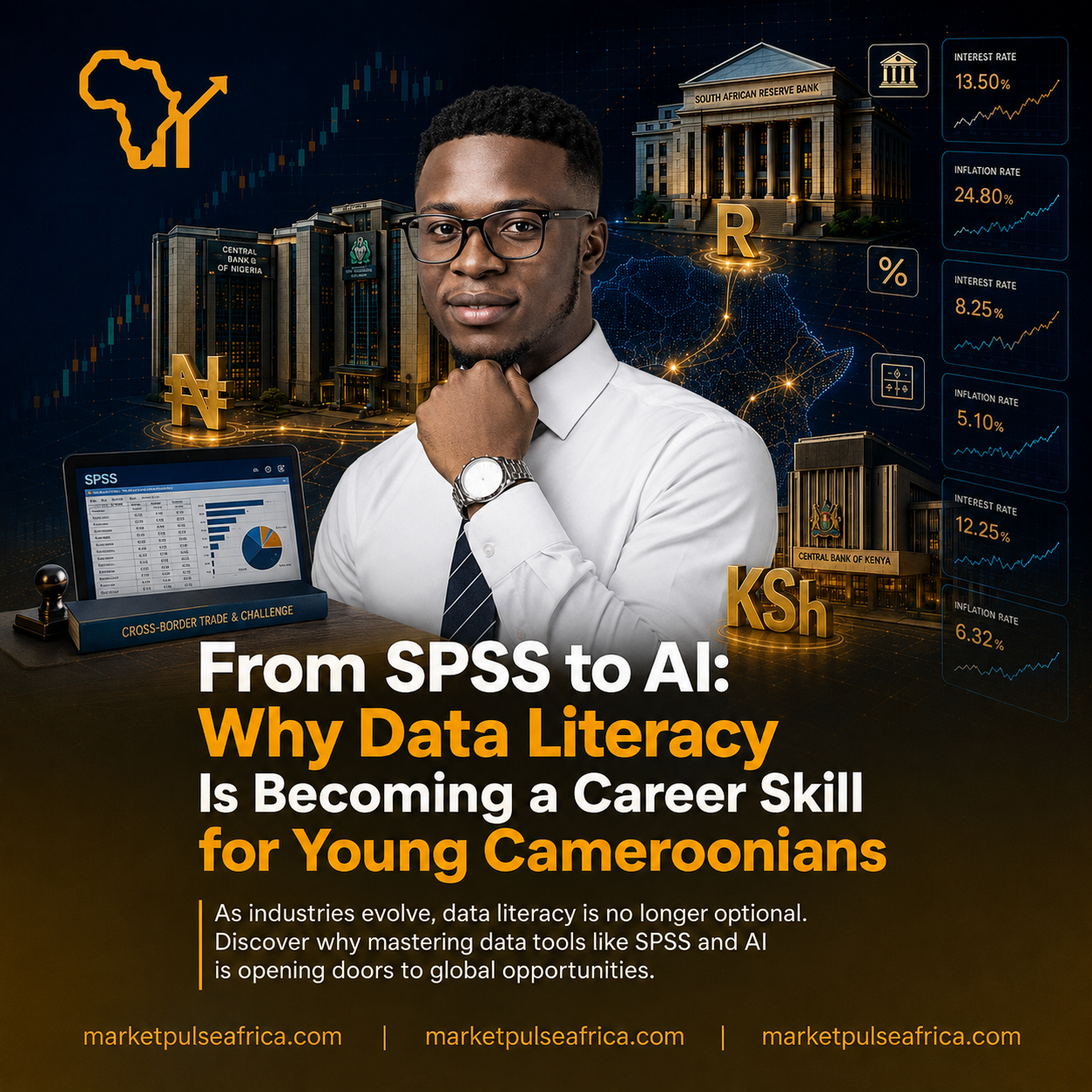
From SPSS to AI: Why Data Literacy Is Becoming a Career Skill for Young Cameroonians
By [Author Name]
Data has become one of the most discussed resources in modern business.
Companies use it to understand customers. Researchers use it to test hypotheses. Governments use it to evaluate programmes. Investors use it to assess markets.
But access to data does not automatically create useful information.
Someone still has to know how to prepare it, analyse it, interpret it and communicate what it means.
That gap is increasingly relevant for young professionals in Cameroon.
In Bamenda, digital marketing professional and trainer Evans Kongnyuy has spent the past three years working with students on exactly this challenge: turning research data into information they can understand and use.
Since 2023, Kongnyuy has conducted five cohorts of data-analysis training, according to figures he provided for this profile.
The programmes have trained more than 50 students directly, while he estimates that his research mentorship, analysis, academic rewriting and project guidance have contributed to the work of more than 100 students.
A Practical Introduction to Statistical Analysis
Kongnyuy's training covers both quantitative and qualitative research.
Students are introduced to descriptive and inferential statistical analysis, data preparation and the interpretation of research findings.
The software used includes SPSS, Microsoft Excel and R.
The emphasis is not simply on learning where to click inside a statistical programme.
The broader objective is to understand the analytical process.
A researcher has to know what question is being asked, what kind of data is available, which method is appropriate and what the resulting numbers actually tell them.
Why the Difference Between Data and Insight Matters
A spreadsheet can contain thousands of observations and still provide little value if nobody knows how to interpret it.
Likewise, a statistical software package can produce a sophisticated-looking table without answering the research question correctly.
This is one reason data literacy is becoming an increasingly important professional skill.
Being data literate does not necessarily mean becoming a professional statistician.
It means being able to understand the basic logic behind data, recognize appropriate analytical methods, interpret results and ask better questions.
For students, that can improve the quality of academic research.
For businesses, the same underlying capability can support market research, customer analysis and decision-making.
Five Cohorts and More Than 50 Direct Trainees
Kongnyuy says his training work has reached more than 50 students across five cohorts since 2023.
The participants have included students and young professionals interested in research and analytical skills.
The training covers areas such as:
Descriptive statistics
Inferential statistics
Quantitative data analysis
Qualitative data analysis
Data preparation
Statistical interpretation
Research methodology
Academic writing
Research presentation
The tools provide the technical environment, but the training is built around understanding the research process.
The objective is not necessarily to master every programme.
It is to understand the principles well enough to choose and use an appropriate tool.
From Excel to R and SPSS
Excel remains one of the most accessible analytical tools for students and small organizations.
It can be used for data cleaning, organization, calculations, tables and basic analysis.
SPSS provides a more specialized environment for statistical analysis and is widely encountered in academic research.
R, meanwhile, provides a programming-based environment that can support more advanced statistical analysis, visualization and reproducible workflows.
Learning multiple tools gives students a broader understanding of how analytical work can be approached.
But the most important skill is not the software itself.
It is understanding what the software is being used to accomplish.
The Arrival of AI in the Research Workflow
The biggest change to research training in recent years has arguably been the rapid development of artificial intelligence.
Kongnyuy has incorporated AI into his training, showing students how it can be used to make parts of research and analysis faster.
AI can assist with tasks such as organizing information, explaining technical concepts, helping researchers structure ideas, supporting repetitive tasks and improving parts of the research workflow.
But there is a significant distinction between using AI to accelerate research and allowing AI to make research decisions without human verification.
The latter creates risks.
AI systems can produce incorrect information, misunderstand context or generate plausible explanations that are not supported by the underlying data.
Researchers therefore still need to verify sources, understand methodology and critically evaluate outputs.
The Academic Research Pipeline
Much of Kongnyuy's work with students takes place within the academic research process.
He estimates that he has contributed to the research work of more than 100 undergraduate and master's students through data analysis, academic rewriting, research mentorship and project guidance.
The students have come from institutions including the University of Bamenda, University of Buea, Catholic University Institute of Buea, Yaoundé International Business School and other professional institutions.
This places the training within a practical environment where students are not simply learning statistical concepts in isolation.
They are encountering those concepts while working on actual research questions.
Research Skills Can Become Business Skills
The relationship between academic research and business analysis is closer than it might first appear.
Consider a business trying to understand why customers are leaving.
The organization might collect survey responses, customer interviews or transaction data.
Someone then has to identify patterns in that information.
That process has similarities to research.
The questions are different, but the underlying skills — collecting evidence, analysing information and drawing defensible conclusions — remain relevant.
This is also where Kongnyuy's digital marketing background becomes relevant.
He has trained students not only in research and data analysis but also in marketing and digital marketing, including the practical application of digital tools to business.
His First-Hand Experience With Data-Driven Marketing
Before developing his data-analysis training programme, Kongnyuy had already been working with digital marketing.
In 2023, he spent three months volunteering as a digital marketer, working alongside digital marketing officer Simplice Sikadi.
The team used social media and telemarketing as part of a student recruitment campaign.
According to Kongnyuy's account, the campaign contributed to the acquisition of more than 100 students across undergraduate, postgraduate and international professional programmes, including ACCA and CIA.
While the recruitment figure would require institutional records for independent verification, the experience illustrates the practical connection between marketing and data.
Campaigns generate information.
Marketers need to understand that information to decide which audiences to target, which messages to improve and where resources should be allocated.
Why Data Skills Matter for Cameroon's Young Professionals
For young professionals entering the workforce, the ability to work with data can complement almost any specialization.
A marketing graduate can use data to evaluate campaigns.
An entrepreneur can use it to understand customers.
A researcher can use it to test hypotheses.
An NGO professional can use it to evaluate programme outcomes.
An analyst can use it to build models and communicate trends.
The common factor is not the industry.
It is the ability to move from information to evidence-based reasoning.
The Risk of Treating Software as a Substitute for Knowledge
One challenge in the growing market for data-analysis training is that software can make analysis look deceptively simple.
Clicking a menu and producing a regression table does not mean that the researcher has conducted an appropriate regression analysis.
Generating a chart does not automatically make the chart meaningful.
And asking an AI system to interpret a dataset does not transfer responsibility for the conclusion to the machine.
The underlying research question remains central.
This is why practical training needs to combine tools with methodology.
AI May Change the Tools, Not the Need for Critical Thinking
Artificial intelligence will likely make some research tasks faster.
That does not eliminate the need for researchers who understand what they are doing.
In fact, faster analytical tools may increase the importance of critical thinking.
If producing an analysis takes minutes rather than hours, the ability to recognize whether the analysis is appropriate becomes even more important.
The future researcher may therefore need to be comfortable with both statistical reasoning and AI-assisted workflows.
A Growing Skills Intersection
Kongnyuy's professional path sits at an interesting intersection.
His work connects:
Digital marketing
Market research
Statistical analysis
Academic research
Artificial intelligence
Professional training
These areas are increasingly connected in the wider economy.
Digital businesses generate data.
Researchers analyse data.
Marketers use data to understand audiences.
AI tools increasingly sit across all of these workflows.
From Student Projects to Professional Capability
For Kongnyuy, the training work has also created a practical mentoring role.
Students often approach data analysis because it is required for a thesis or final-year project.
But the skills they acquire can potentially remain useful after graduation.
Knowing how to structure data, interpret statistical findings and communicate evidence can become part of a professional toolkit.
The challenge is ensuring that students learn the reasoning rather than simply copying a procedure.
What the Next Generation of Analysts May Need
The traditional distinction between researcher, marketer and data analyst is becoming less rigid.
A modern marketing professional may need to understand analytics.
A researcher may need to understand AI.
An entrepreneur may need to understand customer data.
A business analyst may need to communicate findings to people without technical backgrounds.
This does not mean everyone needs to become a statistician or programmer.
It does mean that basic data literacy is becoming increasingly useful across professional fields.
A Local Example of a Wider Shift
Evans Kongnyuy's training activities offer one local example of this broader transition.
Since 2023, he says he has trained more than 50 students directly through five cohorts and supported more than 100 students through different forms of research and academic mentorship.
The work has involved students from universities and professional institutions in Bamenda, Buea, Yaoundé and elsewhere in Cameroon.
His experience also demonstrates how digital marketing and research skills can overlap rather than exist as completely separate career paths.
The Bigger Question Is Not Which Tool to Learn
For students deciding whether to learn Excel, SPSS, R or AI tools, the temptation is to focus on the software.
But the more important question is what they can do with the information once they have it.
Tools change.
Statistical packages evolve.
AI systems become more capable.
The underlying skills remain much more durable:
Ask good questions.
Collect appropriate evidence.
Understand the data.
Choose an appropriate method.
Interpret the results carefully.
Communicate the findings clearly.
Use technology without surrendering judgement.
Those are skills that can travel from a university research project to a business meeting, a marketing campaign or a professional research role.
Conclusion
Cameroon's young professionals are entering a labour market where digital skills and analytical skills increasingly overlap.
The ability to work with data is no longer relevant only to statisticians.
It is becoming useful to marketers, researchers, entrepreneurs, NGO professionals and other knowledge workers.
Evans Kongnyuy's training work since 2023 is one example of how this shift is being reflected at the local level.
Through data-analysis cohorts, research mentorship and digital-skills training, he has been working with students who are learning to use tools such as Excel, SPSS and R while also experimenting with AI-assisted research workflows.
The bigger lesson extends beyond one trainer.
As access to powerful analytical and AI tools becomes easier, the competitive advantage may increasingly belong to people who know not only how to use the tools, but also how to question, interpret and apply the information they produce.