Dangote Refinery IPO: Africa's Biggest Share Sale Opens on the NGX
The Dangote Refinery IPO has opened on the NGX in Africa's biggest-ever share sale — here's what the $49bn listing means for investors. Image ALT text: An African business executive stands before a stock exchange ticker board displaying an upward market trend, with oil refinery towers silhouetted at sunset in the background. Caption: Dangote Petroleum Refinery's N2.15 trillion share offer opened o

Dangote Refinery IPO: Africa's Biggest Share Sale Opens on the NGX
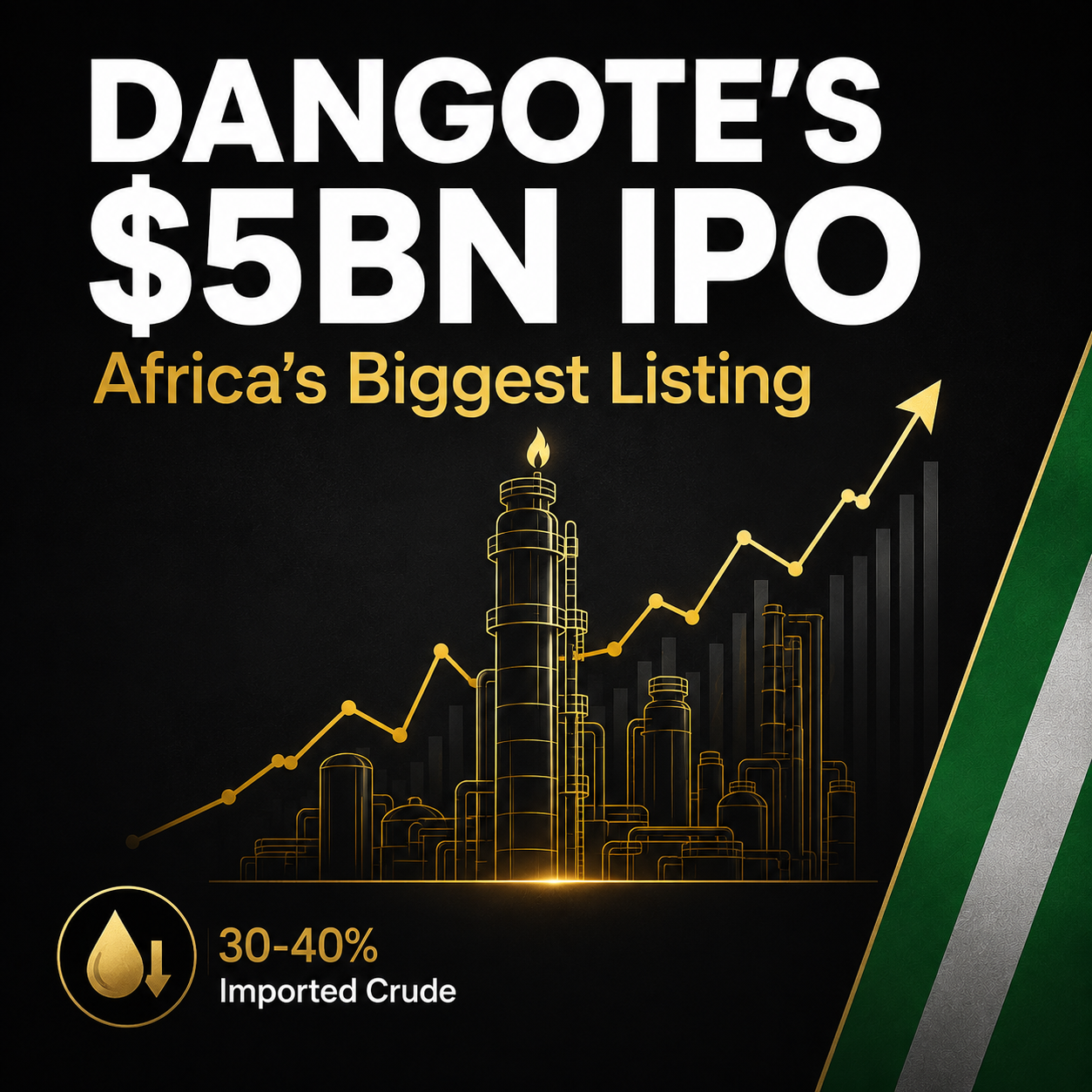
Africa's capital markets are witnessing a transaction of a scale never seen before. On September 14, 2026, Dangote Petroleum Refinery and Petrochemicals opened its initial public offering on the Nigerian Exchange (NGX), putting up 4.1 billion new ordinary shares at N525 apiece in a bid to raise roughly N2.15 trillion, or about $1.63 billion. It is, by every available measure, the largest share sale in African history — and the first time a refinery has gone public on the NGX in the exchange's 66-year existence.
For a continent whose stock markets have historically been dominated by banks, telecoms and consumer goods companies, the listing of a $20 billion, 700,000-barrel-per-day industrial asset is a genuine inflection point. It also lands at a moment when African equities are already having one of their strongest years in recent memory, adding fresh momentum to a market narrative that has increasingly turned in the continent's favor.
What Happened: Inside the Offer
The Dangote Refinery IPO opened for subscription on Monday, September 14, and is scheduled to close on October 13, 2026. Aliko Dangote, president of Dangote Industries Limited, rang the opening gong at the NGX trading floor in Lagos alongside Lagos State Governor Babajide Sanwo-Olu and senior figures from the exchange and its issuing houses.
The offer structure is deliberately accessible. The minimum subscription is just 10 shares, or N5,250, a figure Dangote has framed as an "IPO for the people" designed to widen ownership beyond institutional and wealthy investors. Applications are accepted in multiples of 10 shares, and the offer is open to both domestic and eligible international investors, including diaspora participants working through licensed brokers. Full offer terms and risk disclosures are set out in the official prospectus filed with the Nigerian Exchange.
At the offer price, the refinery is valued at roughly N65.2 trillion, or about $49 billion — a premium of around 17.5% over the $40 billion valuation set during a private placement round completed earlier this year. That earlier round drew participation from sovereign wealth funds and development finance institutions, including the Africa Finance Corporation, alongside reported interest from Gulf state investors. Trading in the new shares is expected to begin on the NGX in November, once allotment is finalized.
From Losses to Record Profit: The Turnaround Behind the Listing
The IPO arrives on the back of a dramatic financial turnaround. The refinery swung from a loss of roughly $282 million to $476 million in prior periods to an after-tax profit of $1.82 billion in the first half of 2026 alone — a reversal that underpins much of the bullish case investors are being asked to buy into. Prospectus disclosures show the business reaching its current throughput of 700,000 barrels per day after years of delayed start-up timelines, crude-supply negotiations with Nigerian producers, and repeated shifts in its petrol rollout schedule since construction began.
Management has also laid out an expansion path: refining capacity is targeted to roughly double, to 1.4 million barrels per day by 2029, under a multi-stage program reportedly budgeted at $14.3 billion. That expansion, rather than the IPO proceeds alone, is likely to define the refinery's next phase of growth.
Why It Matters for Africa
The scale of this listing changes the shape of Nigeria's capital market almost overnight. NGX equity market capitalization stood at roughly N157.6 trillion (about $118.7 billion) as of September 11, 2026. The refinery's indicative valuation could add more than N65 trillion to that figure, pushing total NGX capitalization above N200 trillion for the first time and, by some analyst estimates, accounting for close to a quarter of the exchange's entire value once listed. That would meaningfully narrow the gap between the NGX and larger continental peers such as Morocco's Casablanca Stock Exchange and the Egyptian Exchange, even as South Africa's JSE — valued near $1.5 trillion — remains in a category of its own.
Beyond market-capitalization arithmetic, the listing has real implications for Nigeria's energy security and foreign-exchange position. Domestic refining at this scale reduces the country's reliance on imported refined products, a persistent drain on foreign reserves for decades. There are also continental trade implications: reporting from Reuters indicates the refinery has become an increasingly important supplier of fuel to European markets amid disruptions to Middle Eastern supply routes, underlining how a single Nigerian industrial asset can now influence global product flows, not just domestic ones.
For African investors more broadly, the IPO is a test of whether domestic savings pools — rather than foreign capital — can finance a transaction of this size. Reports indicate that domestic investors have historically accounted for the large majority of NGX trading activity, and this offer is widely seen as a barometer of retail and institutional appetite across the region.
Market Data & Key Numbers
Metric | Figure | As of |
|---|---|---|
Shares on offer | 4.1 billion ordinary shares | Sept. 14, 2026 |
Offer price | N525 per share | Sept. 14, 2026 |
Target proceeds | ~N2.15 trillion (~$1.63bn) | Sept. 14, 2026 |
Minimum subscription | 10 shares (N5,250) | Sept. 14, 2026 |
Implied valuation | ~N65.2 trillion (~$49bn) | Prospectus, Sept. 2026 |
NGX market cap pre-listing | ~N157.6 trillion (~$118.7bn) | Sept. 11, 2026 |
Offer close / listing | Oct. 13, 2026 / Nov. 2026 | Published timetable |
H1 2026 after-tax profit | $1.82 billion | Prospectus disclosure |
It's also worth noting the wider backdrop: African equities have posted some of the world's best returns so far in 2026, even as gold has retreated from its January peak. Nigeria's NGX All Share Index has climbed roughly 72% in dollar terms year-to-date, the strongest performance among a group of African bourses that also includes Zimbabwe, Ghana and the BRVM regional exchange, according to data compiled by Daba Finance. That rally forms the backdrop against which investors are now weighing the Dangote offer.
What Businesses and Investors Should Watch
Market participants tracking this listing should pay attention to a handful of near-term signals:
Subscription levels as the October 13 deadline approaches, and whether the offer is fully covered or requires the reported 15% greenshoe option.
NGX liquidity and index movements, given a stock of this size will materially influence the All Share Index once listed.
The naira reference rate used in the prospectus, since currency movements affect both the dollar value of the raise and investor returns.
Refining margins and crude supply arrangements, which will shape earnings once the company reports as a public entity.
Regulatory guidance from Nigeria's SEC, particularly after a marketing halt earlier this year tied to fraudulent solicitations using the Dangote name.
This is analytical context, not investment guidance — decisions to participate in the offer should be based on the official prospectus and independent financial advice.
Practical Guide: Key Takeaways
For Businesses
Track how a larger NGX capitalization affects Nigeria's standing in regional investment allocation decisions.
Monitor domestic refining capacity trends and their effect on fuel input costs and forex demand.
For Investors
Review the prospectus directly rather than relying on secondary summaries, given the valuation premium over the earlier private placement.
Weigh index concentration risk, since a single listing of this size can shift benchmark performance.
For General Readers
Understand that an IPO raises new capital for the company; it is distinct from the company's later share-price performance on the open market.
Follow official NGX and SEC-Nigeria communications for verified subscription channels, given documented attempts at fraudulent solicitation.
How MarketPulse Africa Helps
Transactions of this size rarely stay contained to one country's market. For readers tracking how Nigeria's biggest-ever listing ripples across regional exchanges, currencies and investment flows, MarketPulse Africa brings together real-time coverage of African equities, forex movements and corporate developments in one place. Our ongoing markets coverage follows the Dangote IPO subscription window, NGX capitalization shifts and broader continental listing activity as the story develops.
Conclusion
The Dangote Refinery IPO is more than a single company's fundraising exercise — it is a stress test for the depth of Nigeria's capital market and a signal of how far African industrial assets can now reach into global capital pools. Whether the offer closes fully subscribed, how the shares perform once listed in November, and how the NGX's expanded capitalization reshapes its standing among African exchanges are all questions worth watching closely over the coming weeks. As always, readers should follow MarketPulse Africa for continued, real-time intelligence on African markets as this story unfolds.