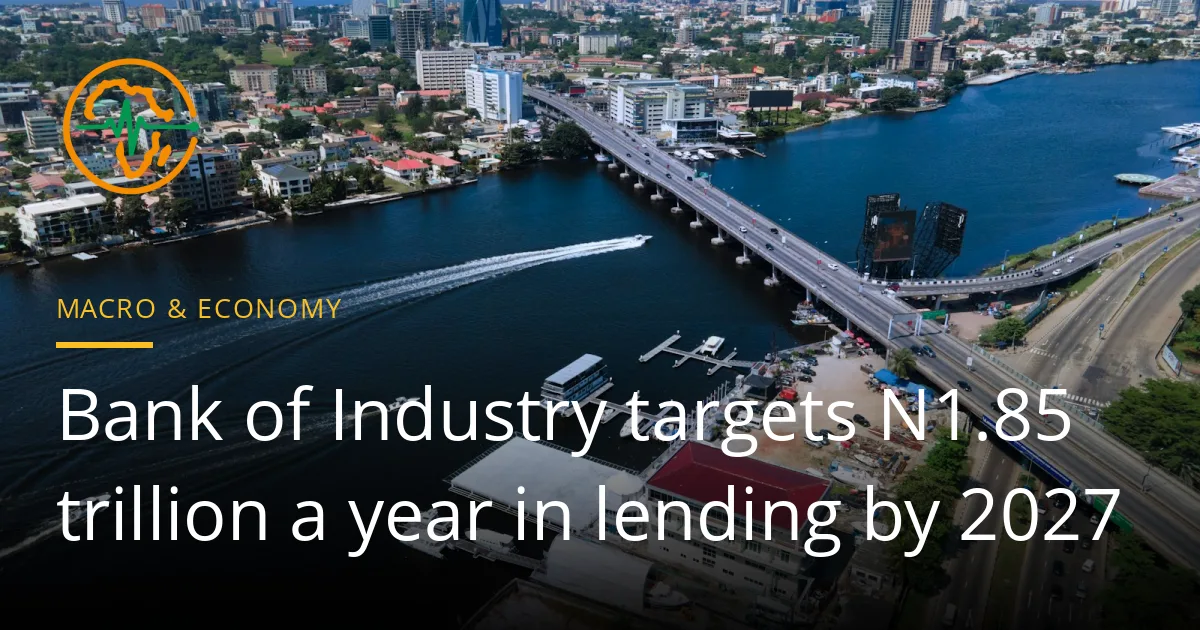
Bank of Industry Lending Target: BOI Wants N1.85 Trillion a Year by 2027, Three Times What It Lent in 2025
Bank of Industry lending is set to rise to N1.85 trillion a year by 2027, from N625 billion in 2025, MD Olasupo Olusi says. The targets, the funding and the risks.
Nigeria's Bank of Industry (BOI) plans to lift its annual lending to N1.85 trillion by 2027, roughly three times the N625 billion it disbursed in 2025. Managing Director Olasupo Olusi set out the target on Thursday, 22 October, at a meeting with media executives in Lagos, Nairametrics reported. He also said the state-owned development lender aims to help create and sustain 3 million jobs and to finance 24,000 micro, small and medium-sized enterprises (MSMEs) by 2027.
"Our mission is very simple. We have to finance what Nigeria makes," Olusi said.
The ambition is clear. The harder question is where the money comes from, and how a lender can triple its annual lending in two years without loosening its standards, at a time when private-sector credit in Nigeria is shrinking.
Bank of Industry lending: the 2025 baseline
According to figures Olusi shared, BOI in 2025:
- disbursed N625 billion,
- reached 12,501 businesses,
- supported the creation and sustainment of 1.6 million jobs,
- gave more than 31% of its funding to MSMEs,
- lent about N120 billion to women-owned businesses.
Going from N625 billion to N1.85 trillion a year means an increase of about 196%. Spread evenly, that is growth of roughly 72% a year in both 2026 and 2027.
The 2025–2027 strategy in brief
The targets sit inside BOI's 2025–2027 corporate strategy, which aims to double the bank's loan book, disbursements and development impact. It has six thematic areas and a simple timeline: 2025 was the foundation year, 2026 is for execution and expansion, and 2027 is for consolidating results.
Priority sectors are manufacturing, agriculture, local healthcare, climate-friendly businesses and technology-driven companies. Olusi said BOI wants to help Nigeria produce more of its own food and medicines.
Planned allocations
| Target group | Planned share |
|---|---|
| MSMEs | 35% of funding |
| Women-owned businesses | 15% of funding |
| Youth-led enterprises | 20% of MSME financing |
| Climate-related investments | at least 10% of the loan portfolio |
BOI also plans to use the $617.7 million Investment in Digital and Creative Enterprises (IDICE) programme to fund technology and creative businesses.
Where the money could come from
BOI has been building its funding base over the past year, according to Nairametrics:
- Local bond market: in August 2026 its inaugural N250 billion Series 1 fixed-rate bond was oversubscribed. It was issued through BOI Financing SPV Plc under a $1 billion multi-currency programme, which leaves room for more issues.
- Development partners: in March 2026 BOI announced an €85 million arrangement with the European Investment Bank, aimed at agricultural value chains, especially cocoa and dairy processing.
- Government programmes: BOI already manages intervention schemes, including a N2 billion entrepreneurship programme for National Youth Service Corps members launched in October 2025, which offers loans of up to N5 million at 9% a year.
Even so, these sources do not add up to an extra N1.2 trillion a year on their own. Reaching the target will likely need further bond issues, more foreign lines of credit and faster recycling of repayments on existing loans.
Why the target stands out in today's credit market
The plan runs against the direction of the wider market. Credit to Nigeria's private sector fell by N537.6 billion in September, even after the Central Bank of Nigeria's biggest rate cut in years, as we reported in Nigeria Private Sector Credit Falls N537.6bn in September. Commercial banks are still earning high yields on government securities, which gives them little reason to lend to small manufacturers.
That is the gap development lenders are meant to fill. Single-digit or low double-digit loans from BOI are far cheaper than commercial bank rates for many small firms, which is why demand for them usually outstrips supply.
Risks to watch
- Loan quality. Tripling disbursements in two years is a big operational step. Faster lending can mean weaker checks, and development banks across Africa have a mixed record on repayment.
- Funding costs. With Nigeria's 10-year bond yield above 17%, BOI's own borrowing is expensive. Lending cheaply while borrowing dearly needs subsidies or concessional money from partners.
- Currency. Part of the funding is in euros and dollars. A weaker naira raises the cost of repaying foreign lines.
- Measuring jobs. "Created and sustained" jobs are hard to verify. Independent reporting of how the figures are counted would make the 3 million target more credible.
What it means for businesses and investors
For manufacturers, farmers and healthcare producers, the message is that BOI expects to have much more money to lend over the next 14 months, with set-asides for small firms, women and young founders. Businesses in priority sectors should prepare audited accounts and clear project plans now, because development lenders tend to fund the applicants who are ready first.
For fixed-income investors, a bigger lending book points to more BOI bond issues under the $1 billion programme. Those will be worth comparing with FGN bonds on yield and risk when they come.
The test will come in BOI's 2026 results: whether disbursements actually rise towards N1.85 trillion, and whether repayments keep pace.