African Equities Weekly Review: Ghana Consolidates After Blistering Rally, Markets Mixed
Ghana's stock exchange cooled after a blistering rally, even as African equities post some of the strongest returns worldwide in 2026.

African Equities Weekly Review: Ghana Consolidates After Blistering Rally, Markets Mixed
African equity markets closed the week ended September 11, 2026 on a mixed note, with West African bourses giving back some ground after months of exceptional gains, even as the broader 2026 narrative for African stock markets remains one of the strongest years on record.
What Happened
The Ghana Stock Exchange Composite Index slipped 1.40% to 14,608 points over the week, continuing a mid-September consolidation following a rally of more than 67% year-to-date. Market commentary attributed the pullback to selective profit-taking as institutional managers rebalanced portfolios after a strong multi-month run, alongside thinning liquidity across select capital markets more broadly. The pattern reflects a common dynamic in fast-rallying markets: after an extended period of gains, some investors lock in profits, leading to short-term pullbacks even when the underlying growth story remains intact.
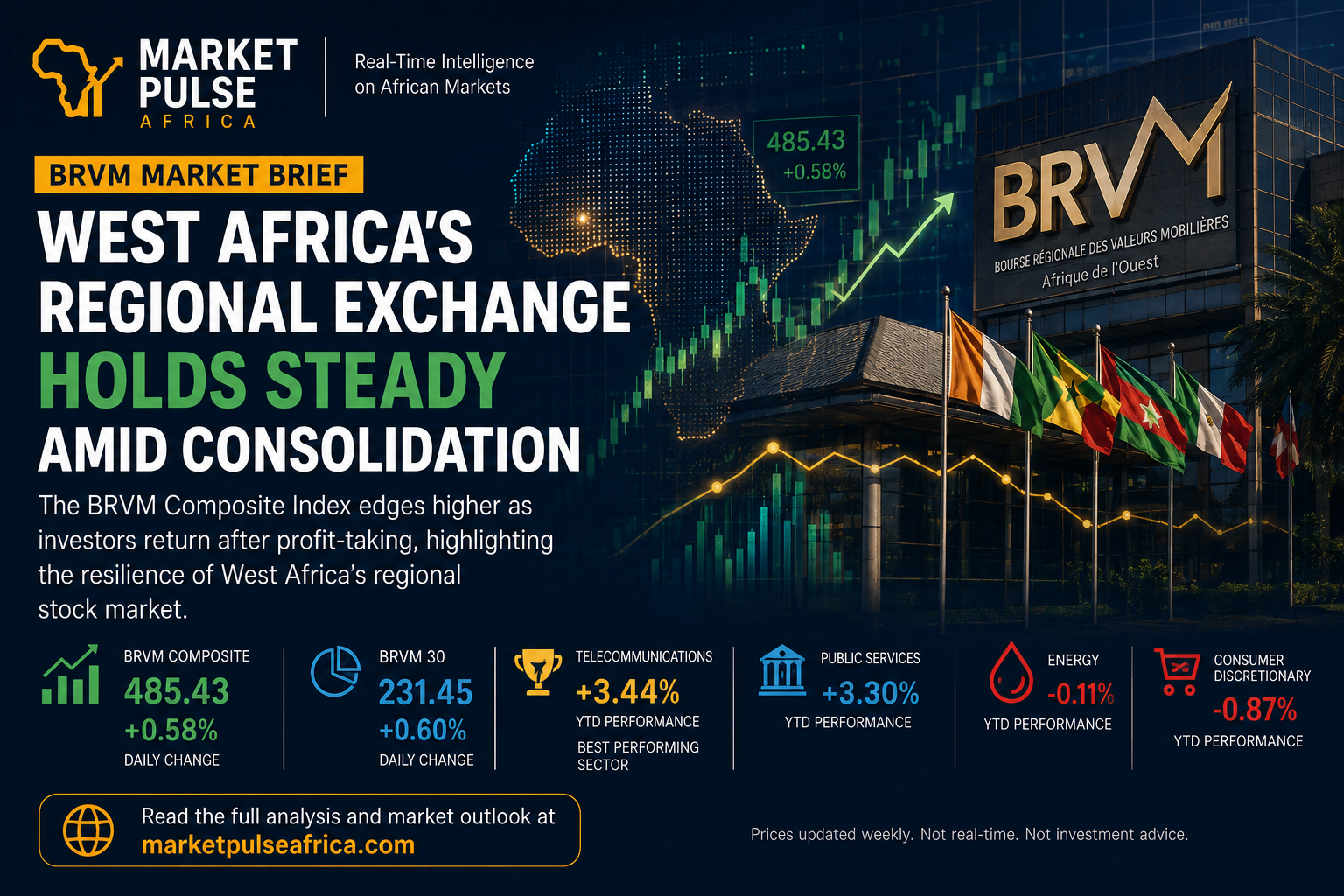
This localized consolidation sits within a much stronger continental picture for 2026 overall. Data compiled across African exchanges earlier this month showed Nigeria's NGX All Share Index up more than 71% in dollar terms since the start of the year — the strongest performance in the group — followed by Zimbabwe at over 70%, Ghana itself at more than 57%, and the BRVM regional exchange, which serves francophone West Africa, at over 53%. Tunisia, Rwanda, Uganda and Kenya also posted double-digit dollar-denominated gains, while Egypt rose more modestly and South Africa's JSE lagged the group with single-digit growth. A handful of markets, including Botswana, Mauritius, Morocco and Malawi, underperformed the broader continental trend.
Historical Context
The scale of gains across African bourses in 2026 stands out against a more turbulent global commodity backdrop: gold prices have pulled back 20% to 22% from their January peak even as equity markets have surged, while oil markets have swung sharply on Middle East geopolitical developments throughout the year. That divergence suggests the rally in African equities reflects growing confidence in listed companies — banks, telecoms, utilities and consumer names — rather than simply riding higher commodity prices, a shift some analysts view as evidence that African exchanges are increasingly being treated as standalone investment destinations rather than indirect commodity plays.
Why It Matters for Africa
Sustained equity market rallies of this magnitude have real implications for African economies: they can lower the cost of capital for listed companies seeking to raise funds, as evidenced by this month's landmark Dangote Refinery IPO on the NGX, and they can draw renewed international investor attention to markets that have historically been under-allocated relative to their economic weight. At the same time, the Ghana pullback is a reminder that even strong structural rallies experience volatility, and that liquidity — the ease with which investors can enter and exit positions without materially moving prices — remains a genuine constraint across several African exchanges.
The next test for the rally, as one market commentary put it, is whether corporate earnings, liquidity conditions and currency stability can sustain the momentum through the remainder of the year, particularly as several African currencies — including the naira — have themselves been stabilising in ways that support dollar-denominated equity returns.
Market Data & Key Numbers
Market | 2026 YTD Performance (USD terms, as of early Sept.) | Week ended Sept. 11 |
|---|---|---|
Nigeria (NGX) | +71.78% | — |
Zimbabwe | +70.21% | — |
Ghana (GSE) | +57.13% | -1.40% (to 14,608 pts) |
BRVM (regional, West Africa) | +53.4% | — |
Tunisia | +43.66% | — |
Rwanda | +40.3% | — |
Uganda | +39.08% | — |
Kenya | +35.87% | — |
Egypt | +24.24% | — |
South Africa (JSE) | +5.15% | — |
What Businesses and Investors Should Watch
Liquidity trends across African exchanges, particularly whether pullbacks like Ghana's reflect genuine profit-taking or deeper concerns about market depth.
Corporate earnings season across the region, which will test whether valuations are supported by underlying fundamentals.
Currency stability, given how closely dollar-denominated returns track local currency movements.
New listings, such as the Dangote Refinery IPO, which can materially shift individual exchange capitalizations and investor attention.
Practical Guide: Key Takeaways
For Businesses
Companies considering African capital markets listings should note the current environment of strong investor appetite, tempered by episodic liquidity constraints.
Monitor currency trends in target listing jurisdictions, given their effect on dollar-denominated investor returns.
For Investors
Distinguish between short-term profit-taking pullbacks, like Ghana's recent move, and genuine trend reversals before adjusting portfolio exposure.
Diversify across African markets rather than concentrating in any single exchange, given the wide dispersion in year-to-date performance.
For General Readers
Understand that a strong year-to-date rally does not mean markets move in a straight line — weekly pullbacks are normal even during structurally strong years.
African equity market performance in 2026 has been notably decoupled from commodity price trends, reflecting broader economic confidence.
How MarketPulse Africa Helps
Tracking performance across a fragmented set of African exchanges — each with its own liquidity profile, currency dynamics and sector composition — requires consolidated, real-time intelligence. MarketPulse Africa brings together weekly market data from the NGX, GSE, BRVM, JSE and other regional bourses in one place, and our markets coverage helps investors and businesses track the continent's strongest-performing exchanges alongside the risks that come with rapid gains.
Conclusion
Ghana's mid-September pullback is a modest note of caution within what remains one of the strongest years on record for African equity markets. With Nigeria's rally reinforced by the landmark Dangote listing, and gains spread across markets from Zimbabwe to Rwanda, the broader continental story remains one of growing investor confidence — even as individual markets navigate the normal ebb and flow of profit-taking along the way. Follow MarketPulse Africa for weekly coverage of African equity market performance through the rest of 2026.