NRS, NUPRC earn N123.54 billion in collection fees from June FAAC revenue
Nigeria's NRS and NUPRC earned a combined N123.54bn in collection fees from June's N3.40tn FAAC distribution — here's the full breakdown.
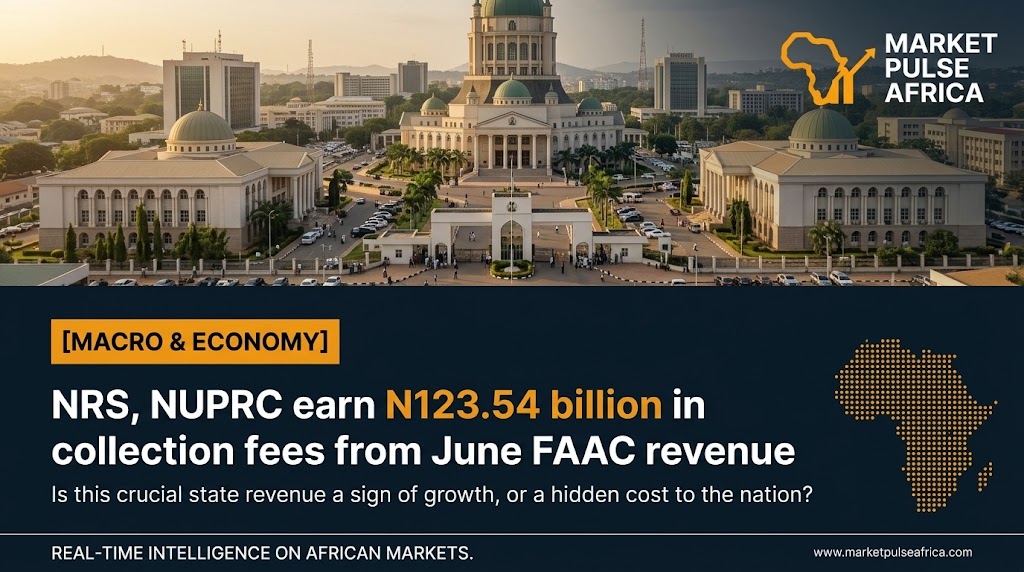
NRS, NUPRC Earn N123.54 Billion in Collection Fees From June FAAC Revenue
Nigeria's two largest revenue-generating agencies collected a combined N123.54 billion in fees for gathering federally distributed revenue in June 2026, according to newly released data — a cost of collection equivalent to roughly 3.6% of the N3.40 trillion shared that month among the Federal Government, states and local governments.
What Happened
The Nigeria Revenue Service (NRS) and the Nigerian Upstream Petroleum Regulatory Commission (NUPRC) received N84.69 billion and N38.85 billion respectively as collection fees from June's Federation Account Allocation Committee (FAAC) disbursement, according to data released by the National Bureau of Statistics (NBS). The figures cover revenue generated in May 2026 and distributed among the three tiers of government in June.
The combined N123.54 billion collection fee rose N9.78 billion, or 8.6%, from N113.76 billion in May, when the NRS received N76.28 billion and the NUPRC received N37.48 billion. The increase tracked a broader rise in total FAAC distributions, which climbed from N3.18 trillion in May to N3.40 trillion in June. June's disbursement comprised N2.65 trillion from the Statutory Account and N743.67 billion from Value Added Tax (VAT), compared with May's N2.13 trillion from the Statutory Account, N806.62 billion from VAT, and a N250 billion augmentation.
Of the June total, the Federal Government received N818.68 billion, states received N759.14 billion, and local governments received N534.28 billion in distributable revenue. Oil-producing states received an additional N188.13 billion under the 13% derivation fund, while the Federal Capital Territory received N30.62 billion.
Historical Context
Collection fees paid to revenue agencies are a standing feature of Nigeria's federal revenue-sharing framework, compensating the NRS (the successor agency handling federal tax and non-oil revenue collection) and the NUPRC (which oversees upstream petroleum revenue) for the administrative cost of gathering the funds before FAAC distributes them across government tiers. The steady month-on-month rise in both total FAAC distributions and the associated collection fees reflects a broader pattern through 2026 of higher federally collected revenue, driven in part by stronger VAT receipts and elevated oil-sector income.
Separately, NBS data released around the same time showed Nigeria's 36 states and the FCT generated a combined N5.15 trillion in Internally Generated Revenue (IGR) in 2025, up 40.93% from N3.65 trillion in 2024 — with Lagos, Rivers and Enugu leading state-level collection — underscoring a parallel trend of states building out their own non-FAAC revenue bases alongside the federally distributed funds covered in this report.
Why It Matters for Africa
FAAC distributions form the fiscal backbone for Nigeria's states and local governments, many of which depend heavily on their monthly allocation to fund salaries, infrastructure and basic services. The scale of collection fees — N123.54 billion in a single month — is a meaningful, if often overlooked, cost embedded in that revenue-sharing process, and tracking its trend alongside total distributions offers insight into both the health of federal revenue collection and the efficiency of the agencies tasked with gathering it.
For a country navigating a still-elevated fiscal deficit and public debt levels — Nigeria's total public debt rose to N166.79 trillion in the second quarter of 2026, according to separate Debt Management Office data — the reliability and growth trajectory of FAAC-distributed revenue matters directly to the government's fiscal flexibility. Rising monthly disbursements, as seen from May to June, offer some reassurance on revenue mobilization even as debt service obligations continue to claim a significant share of federal spending. For the broader West African region, Nigeria's revenue collection trends are closely watched given the country's economic weight and its influence on regional fiscal and monetary policy discussions.
Market Data & Key Numbers
Metric | June 2026 | May 2026 |
|---|---|---|
Combined NRS + NUPRC collection fees | N123.54 billion | N113.76 billion |
NRS collection fee | N84.69 billion | N76.28 billion |
NUPRC collection fee | N38.85 billion | N37.48 billion |
Total FAAC distribution | N3.40 trillion | N3.18 trillion |
Collection fees as % of distribution | ~3.6% | ~3.6% |
Statutory Account component | N2.65 trillion | N2.13 trillion |
VAT component | N743.67 billion | N806.62 billion |
Federal Government share | N818.68 billion | — |
States' share | N759.14 billion | — |
Local governments' share | N534.28 billion | — |
Oil-producing states (13% derivation) | N188.13 billion | — |
What Businesses and Investors Should Watch
Monthly FAAC disbursement trends, as a leading indicator of federal, state and local government fiscal capacity.
Collection fee growth relative to total distributions, to assess whether the cost of revenue collection is rising in line with, faster than, or slower than the revenue base itself.
VAT and Statutory Account composition shifts, which reflect underlying trends in consumption tax receipts versus oil and non-oil federal revenue.
State-level IGR growth, given the parallel trend of states building non-FAAC revenue bases, which affects overall subnational fiscal health.
Practical Guide: Key Takeaways
For Businesses
Track state-level revenue trends, including both FAAC allocations and IGR growth, when assessing subnational government capacity for infrastructure spending or public contracts.
Monitor VAT distribution trends as a proxy for broader consumption activity feeding into federal revenue.
For Investors
Rising FAAC distributions support near-term fiscal stability across government tiers, a relevant factor when assessing sovereign and subnational credit risk.
Compare collection fee growth against total public debt trends to gauge whether revenue mobilization is keeping pace with Nigeria's broader fiscal obligations.
For General Readers
FAAC is the mechanism through which Nigeria's federally collected revenue — from taxes, VAT and oil earnings — is shared monthly among the Federal Government, states and local governments.
The fees paid to agencies like the NRS and NUPRC cover the real administrative cost of collecting that revenue before it's distributed — a routine, if substantial, part of the process.
How MarketPulse Africa Helps
Understanding Nigeria's revenue-sharing mechanics — not just the headline distribution figures — is essential for assessing the fiscal health of government at every level. MarketPulse Africa tracks FAAC disbursements, state-level revenue trends and broader fiscal policy developments, helping readers connect monthly revenue data to Nigeria's wider public finance and debt picture.
Conclusion
The N123.54 billion in June collection fees paid to the NRS and NUPRC reflects both the scale of Nigeria's federally distributed revenue and the routine cost of gathering it — a figure that rose in step with a broader increase in total FAAC disbursements from May to June. As Nigeria continues to navigate elevated public debt and fiscal pressures, monthly FAAC data will remain a key indicator to watch for the health of government revenue at every level. Follow MarketPulse Africa for continued coverage of Nigeria's fiscal and revenue trends.