NGX sheds N256 billion as five-day losing streak deepens
The NGX lost N256 billion on Tuesday, extending its losing streak to five sessions, even as the index's year-to-date gain remains above 60%.
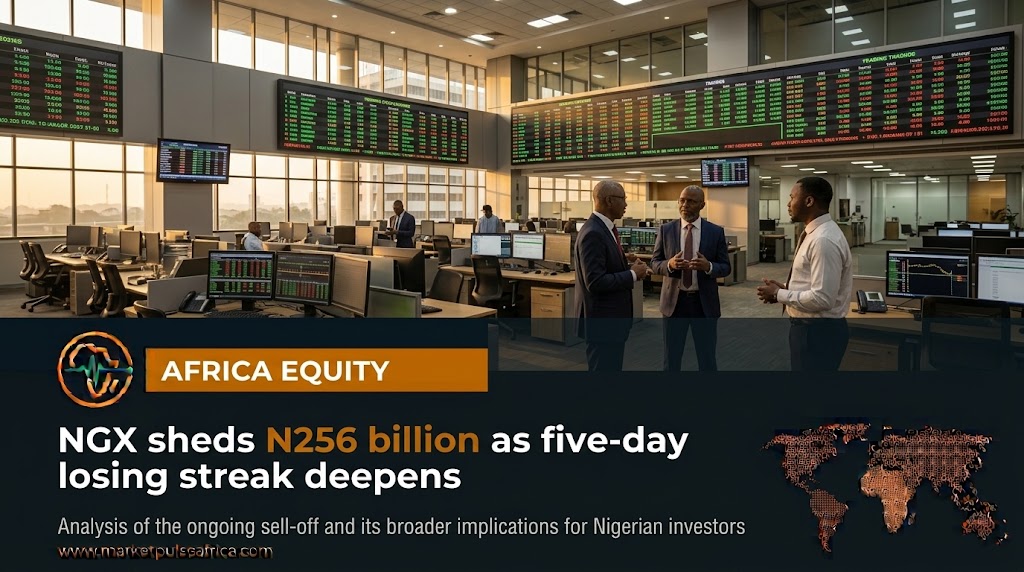
Searched the web NGX Sheds N256 Billion as Five-Day Losing Streak Deepens Five days. That's how long Nigeria's stock market has now been sliding, after investors shed another N256 billion on Tuesday, October 6 — a decline that's chipping away at what had been one of the best years for Nigerian equities in recent memory, even as the market's year-to-date gain remains well above 60%.
What Happened The NGX All-Share Index fell 394.36 points, or 0.16%, to close at 250,273.50 points on Tuesday, down from 250,667.86 points the previous session. Market capitalisation dropped by N256.05 billion, settling at N162.495 trillion from N162.751 trillion. The losing streak now stretches back to Tuesday, September 29, marking the market's fifth consecutive negative session.
Market breadth told a similarly bearish story: 34 stocks declined against just 26 gainers on the day, worsening from Monday's split of 29 decliners to 24 gainers. Trading activity also pulled back sharply — total volume fell 33.82% to 579.25 million shares, turnover dropped 11.75% to N36.07 billion, and the number of executed deals declined 23.78% to 41,072 transactions, suggesting the sell-off was accompanied by thinner overall participation rather than a rush for the exits.
Banking stocks led the decline. The NGX Banking Index dropped 1.25% to 2,653.93 points, dragged down by a 5.09% fall in First HoldCo to N142.50, alongside losses in Ecobank Transnational Incorporated (-2.72% to N68.00) and Wema Bank (-1.43% to N31.50). Other large-cap names weighing on the session included Unilever Nigeria, Fidson Healthcare and Stanbic IBTC Holdings. Not every sector moved lower, though: the NGX Insurance Index bucked the trend, gaining 0.53% to 1,093.41 points on strength in Sovereign Trust Insurance (+8.23%), Coronation Insurance (+7.69%) and Guinea Insurance (+7.35%). The Oil & Gas, Industrial and Consumer Goods indices all closed essentially flat.
Historical Context Despite five straight days of losses, the NGX All-Share Index's year-to-date gain still stood at 60.83% as of Tuesday's close — a reminder of just how strong 2026 has been for Nigerian equities even with this recent pullback. The index had been riding a sustained rally through much of the year, driven by renewed buying interest in banking and oil and gas names, strength in large-caps like Seplat Energy and Dangote Cement, and broader momentum that made the NGX one of the best-performing exchanges globally in dollar terms. That same rally produced the kind of overbought technical conditions some analysts had already flagged in late September, right before TotalEnergies Nigeria's sharp single-stock reversal pulled the oil and gas sector gauge down from its own record high.
The current slide is widely being described by market commentators as profit-taking rather than a fundamental reassessment of Nigerian equities — investors locking in gains after months of sustained appreciation, a pattern that tends to follow extended rallies regardless of the underlying market's longer-term health.
Why It Matters for Africa A five-day losing streak, even a modest one in percentage terms, is a useful reminder that Nigeria's 2026 rally — however strong on a year-to-date basis — isn't immune to the normal rhythms of profit-taking and sentiment shifts that affect every equity market. For investors who've been riding the NGX's gains this year, the current pullback raises the practical question of whether this is a routine pause within a still-intact uptrend, or the early signs of a more sustained reversal. The answer matters not just for domestic Nigerian investors, but for the international capital that has increasingly been drawn to Nigerian equities as the market's dollar-denominated returns have outpaced most global peers this year.
The sector divergence within the sell-off is also instructive. Banking stocks — among the biggest drivers of this year's rally — have led the recent decline, while insurance names have moved in the opposite direction, continuing to benefit from the sector's own ongoing recapitalisation story. That split suggests the current weakness is concentrated rather than broad-based panic, a distinction that matters for how investors and analysts read the market's near-term direction heading into the rest of October.
Market Data & Key Numbers Metric Tuesday, Oct. 6 Previous Session NGX All-Share Index 250,273.50 points 250,667.86 points Daily change -394.36 points (-0.16%) — Market capitalisation N162.495 trillion N162.751 trillion Daily market cap change -N256.05 billion — Year-to-date ASI return +60.83% — Losing streak length 5 consecutive sessions Since Sept. 29, 2026 Market breadth 34 decliners vs. 26 gainers 29 decliners vs. 24 gainers (Mon.) Trading volume 579.25 million shares (-33.82%) — Turnover N36.07 billion (-11.75%) — Executed deals 41,072 (-23.78%) — NGX Banking Index -1.25% to 2,653.93 points — NGX Insurance Index +0.53% to 1,093.41 points — What Businesses and Investors Should Watch Whether the losing streak extends into a sixth session, or whether banking and large-cap names find support in the coming days. Trading volume trends, given Tuesday's declining turnover alongside falling prices — a pattern that can signal either fading selling pressure or genuine investor caution. Insurance sector performance, which has continued moving independently of the broader market's direction, tied to its own ongoing recapitalisation narrative. Whether this remains contained to profit-taking or starts to reflect a broader shift in sentiment toward Nigerian equities after an unusually strong year. Practical Guide: Key Takeaways For Businesses Companies planning capital raises or listings on the NGX should monitor whether the current pullback affects investor appetite for new offerings in the near term. Track sector-specific divergence, since banking and insurance stocks are currently moving in opposite directions despite both sitting within the same broader market sell-off. For Investors A five-day losing streak after a 60%-plus year-to-date rally is not unusual and doesn't by itself signal a change in the market's underlying trend — context and duration matter more than any single data point. Watch market breadth and trading volume together, not just the headline index level, for a fuller picture of whether selling pressure is broadening or narrowing. For General Readers A stock market "losing streak" refers to consecutive sessions where the benchmark index closes lower than the day before — it doesn't necessarily mean a crash or a reversal of a longer-term trend. Nigerian equities remain up more than 60% for the year despite this pullback, illustrating the difference between short-term volatility and a market's broader year-long performance. How MarketPulse Africa Helps Daily and weekly swings on the NGX can obscure the broader trend unless they're tracked consistently over time. MarketPulse Africa follows NGX market performance session by session alongside our wider coverage of Nigerian equities, helping investors separate routine profit-taking from genuine shifts in market sentiment.
Conclusion Tuesday's N256 billion decline extends the NGX's losing streak to five sessions, but the market's year-to-date gain of nearly 61% puts the current pullback in perspective as a pause within a still-strong 2026 rally rather than a reversal of it. Whether banking stocks stabilise and the streak breaks in the coming sessions, or the sell-off deepens further, will be the next signal worth watching. Follow MarketPulse Africa for continued daily coverage of NGX market performance.