The new scramble for Africa (1): The minerals are African; the power is somewhere else
Africa holds a large share of the minerals the energy transition needs, and the US, China and others are competing for them. The value, however, is still mostly captured outside the continent. Part one of a series.
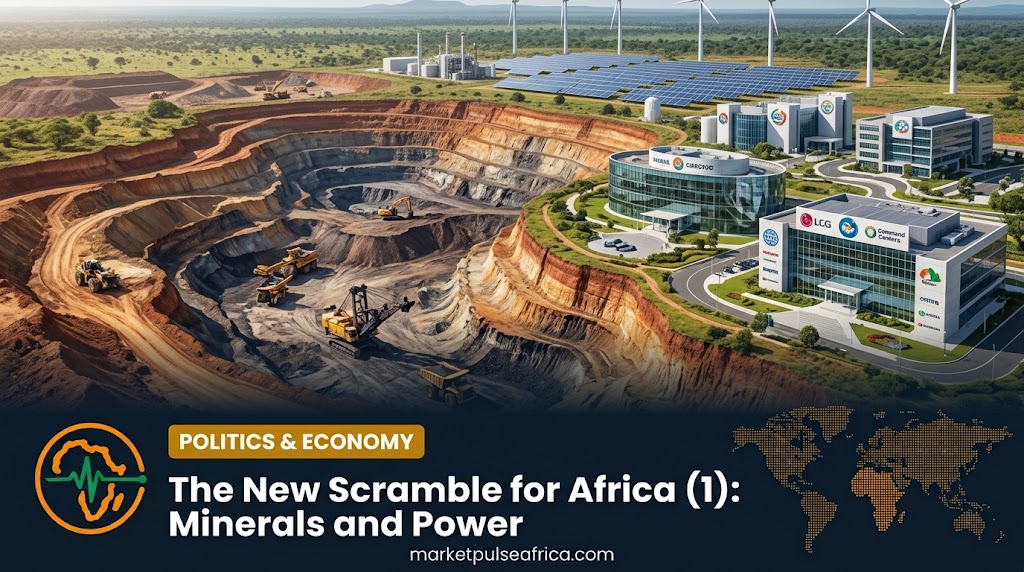
Africa holds a large share of the minerals the world's batteries, grids and electronics depend on, and the powers competing for them are increasingly building the factories that turn those minerals into finished materials elsewhere. The United States, China, the European Union and others are all moving into the continent, with minerals deals, financing and infrastructure. Yet much of the value still leaves Africa as ore, concentrate or semi-processed material. This is the first part of a series on the new scramble for Africa. It looks at what is being offered, what is being taken, and why the choice of where minerals are refined matters more than who digs them out of the ground.
Contents
- The prize: Africa's minerals
- The competition: US, China and others
- Where the value goes
- Governments push back
- What to watch in the series
The prize: Africa's minerals
Africa is often described as holding around 30 percent of the world's known critical mineral reserves, a figure cited by Brookings in its analysis of Africa's position in the global supply chain. The continent's reserves include cobalt and copper in the Democratic Republic of Congo and Zambia, lithium in Zimbabwe and Nigeria, graphite in Tanzania, bauxite in Guinea and rare earths and niobium in Kenya. These are the materials used in electric vehicle batteries, renewable energy equipment and electronics.
Demand is the reason the competition has intensified. As the energy transition accelerates, buyers in Washington, Beijing, Brussels and New Delhi are looking for secure sources outside the markets they already depend on. For African governments, that demand creates leverage. For companies and investors, it creates both opportunity and risk.
The competition: US, China and others
The United States has moved quickly. In February 2026, it announced Project Vault, a $12 billion initiative that creates a strategic critical minerals reserve for US industry, backed by the Export-Import Bank and private capital. In September 2026, the United States and Nigeria signed a minerals memorandum of understanding that covers exploration, mining, processing, refining and value addition. Washington has also signed bilateral frameworks with Guinea and Morocco, and has declared an intention to help Kenya build a processing industry. The Lobito Corridor, linking the Democratic Republic of Congo and Zambia to Angola's Atlantic coast, is another US-supported project.
China has been present for longer and is deeper in the supply chain. Analysts describe China's approach as fully integrated, from mine to refinery, with faster financing and a long track record of processing investment. Commentary on the competition points to a $1.3 billion Chinese investment in lithium processing in Nigeria, and to continued Chinese involvement in copper and cobalt across the DRC and Zambia. The European Union has also signed strategic partnerships on critical raw materials with Namibia, Zambia and the DRC.
The competition is not only between the US and China. Gulf states, India and other buyers are also looking for access, and African governments are negotiating with several partners at once.
Where the value goes
The central question is where the value is captured. Mining generates revenue, jobs and royalties, but the largest profits in battery materials usually come from refining, chemical processing and manufacturing. A 2026 analysis from the Africa-China Centre found that most investment in Africa remains concentrated in early-stage processing, rather than advanced refining, precursor manufacturing or battery production. Much of the higher value-added processing still happens in China.
Brookings made a similar point in its analysis of the US-Ukraine critical minerals agreement, warning that a deal can secure access for buyers while leaving the supplying country with limited value added. The risk is that African countries become reliable suppliers of raw material and stay dependent on partners' factories for the most profitable steps.
There are examples of change. Guinea is developing bauxite processing to produce alumina domestically. Zambia has invested in copper smelting and refining and is pushing for local processing of copper cathodes and battery precursors. Tanzania is building graphite processing plants for the battery industry. Kenya's president has said that rare earth minerals will be processed in Kenya under a planned arrangement with the United States. These projects are early, and their scale and financing still have to be proven.
Governments push back
Several governments have begun to restrict raw exports to force processing at home. Zimbabwe suspended exports of raw lithium concentrate in 2026. That step has pushed Chinese companies to invest in local processing, rather than simply shipping ore out. Other producers have set similar goals, though the enforcement and timing vary widely.
Export bans carry trade-offs. They can raise domestic value and create jobs, but they can also deter investment if investors cannot secure the power, water, logistics and skilled labour that processing requires. They can also push buyers to look for supplies elsewhere, which weakens the bargaining position they were meant to strengthen.
What to watch in the series
This first part sets out the competition and the question of value. The next parts will look at specific deals and their terms, the power and infrastructure needed for processing, the financing models on offer, and how governance and local ownership shape outcomes. The test for each deal is simple: does it move more of the value into Africa, and does it leave the country better able to process its own minerals in the future?
Investors and business leaders should watch the terms of each agreement closely. Offtake contracts, royalty rates, local content rules and processing commitments will decide who benefits, and those terms are often easier to change at the start of a deal than later.