Cocoa Rebounds: What Higher Prices Mean for West and Central African Producers
Cocoa prices climbed around 3.18% to approximately $5,719 per tonne, bringing fresh attention to the economic impact on West and Central Africa's major producing countries. But the key question is not simply whether cocoa prices are rising — it is who ultimately captures the gains.
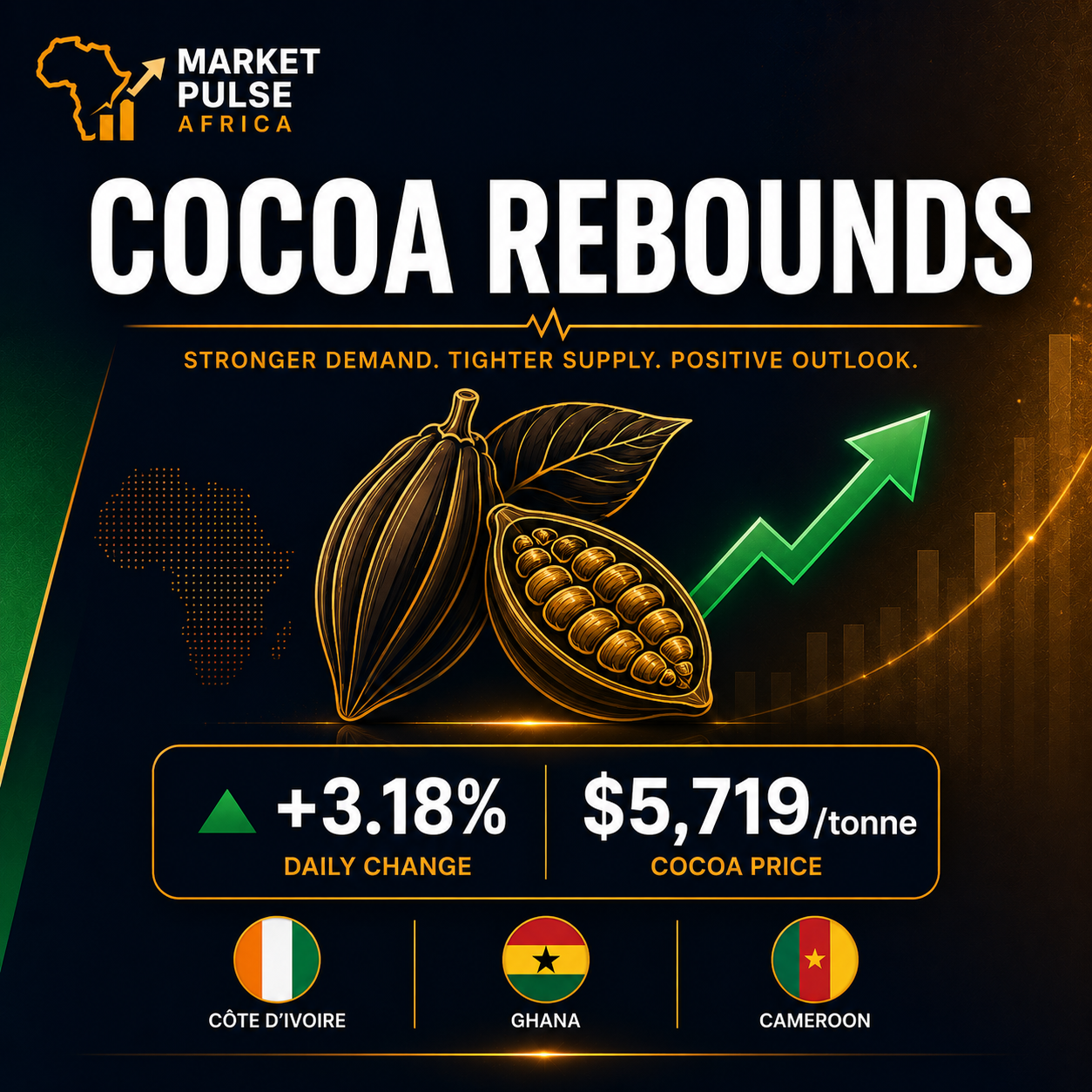
Cocoa prices rebounded to around $5,719 per tonne in Friday's market data, rising approximately 3.18% and bringing renewed attention to one of West and Central Africa's most economically important commodities.
For a commodity market dominated by African producers, a move of this size has implications that extend well beyond trading screens.
Côte d'Ivoire and Ghana account for the majority of global cocoa production, while Cameroon and Nigeria also make significant contributions to international supply.
Because of this concentration, major movements in cocoa prices can function almost like a broader economic indicator for the region rather than simply another change in the soft commodities market.
The important question, however, is not just whether cocoa prices are rising.
The more important question is: who actually captures the gains?
Why Cocoa Prices Matter to West and Central Africa
Cocoa remains deeply connected to the economies of several African countries.
For producing nations, higher global prices can potentially generate benefits across the entire value chain — from smallholder farmers to exporters, processors, governments and logistics companies.
The economic mechanism is relatively direct.
A higher global cocoa price can increase the potential revenue generated from exports. That additional income can then strengthen foreign-exchange inflows and support government revenues.
The effects can eventually spread through wider parts of the economy.
The Cocoa Price Chain
A sustained increase in cocoa prices can potentially create the following cycle:
Higher global cocoa prices
Increased potential farm-gate prices for producers
Stronger export revenues
Increased foreign-exchange inflows
Support for currency stability
Improved government revenue
Higher earnings for cocoa-related businesses
However, this chain does not always operate automatically.
The distribution of the benefits depends heavily on domestic policies, existing contracts and the structure of the cocoa industry in each country.
Côte d'Ivoire and Ghana Remain Central to the Market
Côte d'Ivoire and Ghana remain the two most important countries in the global cocoa market.
Together, they supply a substantial share of the world's cocoa, meaning developments in their production, pricing policies and export systems can influence the wider global market.
Cameroon and Nigeria also play important roles in the regional cocoa economy.
For these countries, cocoa exports generate valuable foreign exchange and support large agricultural communities.
A sustained recovery in prices could therefore improve export earnings across West and Central Africa.
But higher international prices do not necessarily mean that farmers immediately receive more money.
Do Higher Prices Reach Cocoa Farmers?
This is one of the most important questions surrounding every major cocoa rally.
Global cocoa prices may rise sharply, but the amount received by individual farmers depends on how national pricing systems operate.
In countries with regulated farm-gate pricing systems, changes in international market prices may take time to reach producers.
Farm-Gate Pricing Matters
Ghana and Côte d'Ivoire both operate systems that influence the prices paid directly to cocoa farmers.
These policies are designed to provide producers with greater income stability and protect farmers from extreme market volatility.
However, they can also mean that farmers do not immediately receive the full benefit of a sudden increase in international cocoa prices.
The timing of government pricing announcements therefore becomes extremely important.
If global prices remain elevated, producing governments may face increasing pressure to revise farm-gate prices upward during the next pricing cycle.
Export Contracts Can Limit Immediate Gains
Another important factor is timing.
Not all cocoa is sold at today's market price.
Exporters, marketing boards and trading companies may have already committed part of a harvest under contracts negotiated at earlier prices.
That means a price increase in the futures market does not automatically translate into immediate additional revenue for every producer.
The benefit depends partly on:
How much cocoa has already been sold
The prices agreed under existing contracts
The timing of future export sales
The structure of national marketing systems
Currency movements
Countries with greater exposure to future sales at higher prices could benefit more directly from a sustained rally.
Foreign Exchange and Currency Stability
Higher cocoa prices can also matter at the macroeconomic level.
Cocoa is a major source of foreign currency for several West and Central African economies.
Stronger export revenues can increase foreign-exchange inflows, helping governments and central banks manage external pressures.
Additional foreign currency entering the economy can potentially support:
Currency stability
Foreign-exchange reserves
Import financing
Balance-of-payments conditions
Inflation management
For countries facing pressure on their currencies, stronger agricultural export earnings can provide an important source of economic support.
The Corporate Winners Could Look Different
The benefits of higher cocoa prices are not always distributed evenly across the value chain.
Smallholder farmers may benefit through higher farm-gate prices, while governments can benefit from stronger export revenues and taxes.
At the same time, companies involved in cocoa trading, processing and export logistics may also capture a significant share of the value created by higher prices.
This raises an important issue for investors and policymakers:
Who captures the largest share of the cocoa price rally?
Smallholder Farmers
Farmers benefit most directly when higher global prices are reflected in improved farm-gate payments.
National Marketing Boards
Government agencies and marketing systems can influence how export revenues are distributed and how pricing is managed domestically.
International Trading Companies
Large trading houses may benefit from higher volumes, trading margins and their ability to manage contracts across global markets.
Cocoa Processors and Logistics Companies
Companies involved in processing, transportation and exports may also experience changing revenues as market prices and supply conditions evolve.
A Higher Price Does Not Guarantee a Bigger Economic Gain
For Market Pulse Africa's audience, simply reporting that cocoa is rising does not tell the complete story.
A higher price is only the beginning of the analysis.
The real economic impact depends on how much of the price increase reaches farmers, how much additional export revenue enters producing economies and how governments manage those gains.
Other factors also matter, including currency movements and the proportion of export earnings that remain within domestic economies.
A country may record stronger cocoa export revenues without seeing an equally significant improvement in household incomes.
That is why farm-gate pricing decisions will be among the most important indicators to watch.
What Comes Next?
The durability of the latest cocoa rebound remains uncertain.
A single-day increase does not necessarily signal a sustained new trend.
Markets will continue monitoring production forecasts, weather conditions, export data and global demand.
For West and Central African producers, however, the next major development could come from policymakers rather than commodity traders.
Farm-gate pricing announcements from Accra and Abidjan will be particularly important in the weeks ahead.
If global cocoa prices remain elevated, governments may face pressure to reassess the prices paid to farmers ahead of future harvest cycles.
The outcome will help determine whether the latest cocoa rally becomes a meaningful economic benefit for producing communities or whether much of the additional value remains concentrated elsewhere in the global supply chain.
Market Pulse Africa will continue tracking cocoa prices, farm-gate pricing announcements, export revenues and the broader impact of the market on West and Central African economies.