
COBAC Prudency Rules: Commercial Bank Capital Adequacy Ratios across CEMAC States
COBAC raised the minimum share capital of CEMAC banks from CFA 10 billion to CFA 25 billion from January 2026. Here is what the rule requires, how Cameroonian banks are responding, and what capital size does and does not tell investors.
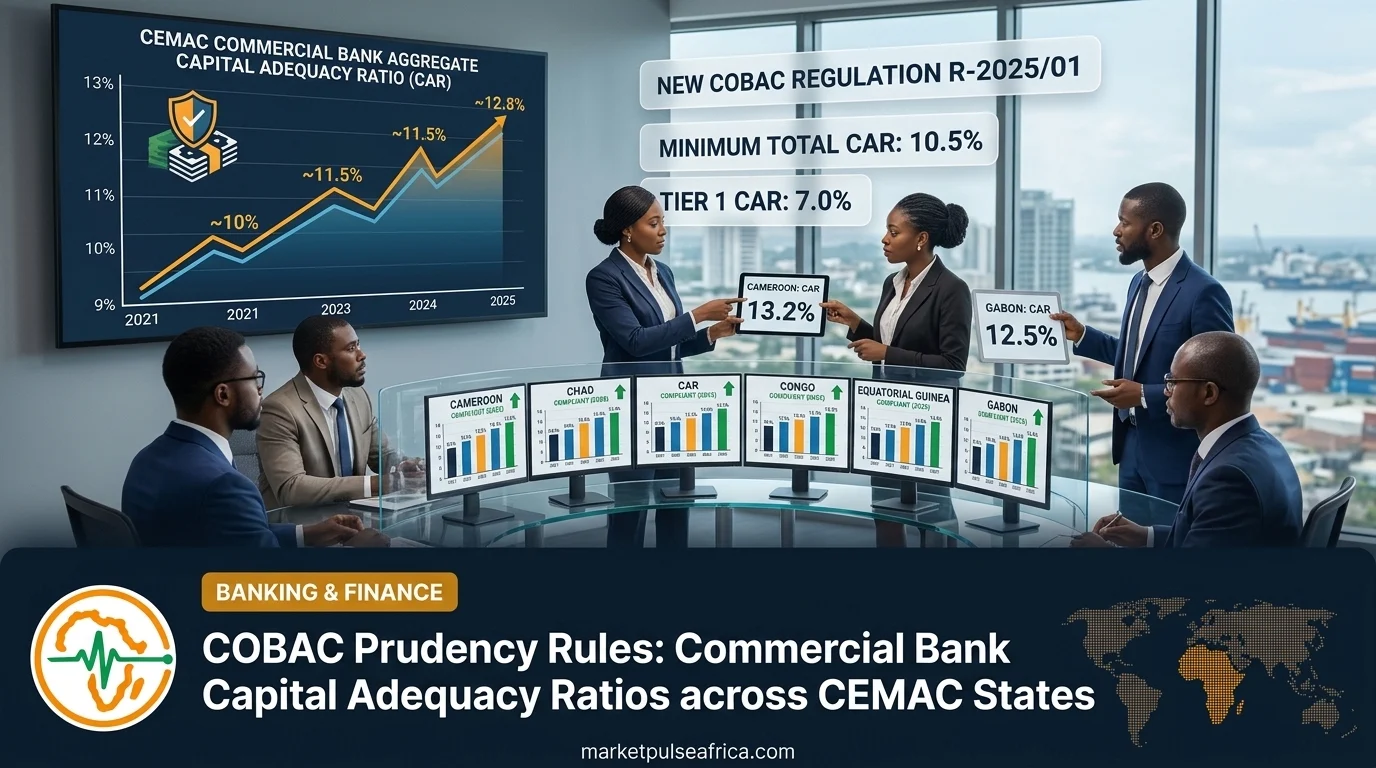
Every commercial bank in the six CEMAC countries now needs two and a half times the share capital it needed a year ago. Cameroon's 19 banks have until the end of 2026 to show they meet it.
COBAC Regulation R-2025/02, adopted on 10 December 2025 and effective 1 January 2026, raised the minimum share capital of CEMAC banks from CFA 10 billion to CFA 25 billion (a 150% rise) and of financial institutions to CFA 4 billion; banks short of the threshold at 31 December 2026 had to submit a recapitalisation plan to COBAC by 30 June 2026, on pain of sanctions up to withdrawal of their licence. The rule follows a 2024 survey in which 22 of the region's 56 banks failed to meet all capital-related prudential standards.
This brief covers what the rule requires, the weak spots in the 2024 data, how Cameroonian banks are responding, and the signals for investors.
- What the regulation requires
- Why COBAC acted
- Capital size versus capital adequacy
- How Cameroonian banks are responding
- What it means for investors
- Related Reading
What the regulation requires
COBAC, the Central African Banking Commission, adopted the new capital rule at an extraordinary session in Libreville on 10 December 2025. The regulation is COBAC R-2025/02. Ecofin reports that it applies to Cameroon, Congo, Gabon, Equatorial Guinea, the Central African Republic and Chad.
The new thresholds from 1 January 2026
- Banks: minimum share capital of CFA 25 billion, up from CFA 10 billion
- Financial institutions: minimum share capital of CFA 4 billion
- Existing banks below the threshold: a capital increase plan to the COBAC Secretary General by 30 June 2026, with sanctions up to withdrawal of approval for non-compliance
The regulation includes transitional provisions for existing banks, and Tchad Infos reports interim thresholds, with CFA 14 billion at the end of 2026 as the first step. The previous revision dates from 2009, when COBAC first took over the power to set capital thresholds.
Takeaway: the 2026 rule is a size requirement, so a bank can meet it and still fail on risk-based ratios.
Why COBAC acted
The CEMAC Commission's 2024 multilateral surveillance report, published on 15 December 2025, found that ten banks, including five in Chad, recorded an overall net capital shortfall of CFA 247.3 billion (about US$442.5 million). It also found that 22 of the 56 banks in the region failed to comply with all prudential standards on net capital, close to 40% of the system.
The report attributes this largely to incomplete implementation of COBAC decisions by some national authorities. According to COBAC, as reported by Ecofin, the reform aims to strengthen financial resilience and risk-absorption capacity and to support the financing of regional economies. Ecofin describes it as part of implementing Basel-inspired prudential standards, at a time of rising non-performing loans in several CEMAC countries.
Capital size versus capital adequacy
Two different tests apply to a CEMAC bank. The first is the fixed minimum capital. The second is a set of risk-based ratios. A Financial Afrik analysis lists the Basel III-inspired ranges as a CET1 ratio of at least 4.5% to 7%, a Tier 1 ratio of at least 6% to 8.625% and a total solvency ratio of 8% to 12.5%, depending on the buffers that apply.
The analysis argues that the two logics differ: Basel III regulates risk through ratios, while the new rule regulates size through an absolute amount, which it calls essentially a measure of size, not quality. It also warns that the threshold risks pushing the region toward consolidation. That is an opinion piece, and COBAC's own view is that higher capital improves resilience.
How Cameroonian banks are responding
Ecomatin counted 19 active banks in Cameroon and reported that only four met the new threshold at first and that Cameroonian banks together needed to find about CFA 180 billion. A later Ecomatin tally said six commercial banks had complied, with Commercial Bank Cameroon at CFA 24 billion, or 96% of the threshold.
Recapitalisations reported
- BGFIBank Cameroon: its board approved a capital increase on 27 February 2026 from CFA 20 billion to CFA 50 billion, double the new threshold
- Afriland First Bank: share capital increased to CFA 110 billion from CFA 50 billion with no fresh funding, 4.4 times the minimum, and the bank did not disclose updated prudential ratios
- Société Générale Cameroun, Ecobank and NFC Bank: reported by Ecomatin to be launching recapitalisation processes
The Afriland case shows a limit in the rule. A share capital increase with no fresh funding raises the nominal figure without adding new money to the bank, so the capital number alone does not answer the adequacy question.
What it means for investors
- Check how the capital was raised. New cash, retained earnings and reserve capitalisation have different effects on the balance sheet.
- Look at the ratios, not only the share capital. Ask for CET1, Tier 1 and total solvency figures alongside the headline number.
- Expect consolidation. Banks that cannot raise the sum may merge or exit, which could change market shares in Cameroon and Chad.
- Watch the 31 December 2026 deadline. COBAC's notices on non-compliant banks will be the first test of enforcement.
Banking regulation also interacts with the currency controls we describe in our report on BEAC foreign exchange allocation, and with the thin local capital markets covered in our piece on DSX liquidity and Cameroonian corporate debt. For a comparison with the same kind of recapitalisation in another market, see NGX insurance recapitalisation.
Related Reading
- Read our full coverage of BEAC foreign exchange allocation and remittance delays
- Read our full coverage of NGX insurance recapitalisation and consolidation risk
- Read our full coverage of DSX liquidity bottlenecks and Cameroonian corporate debt
Will Cameroon's banks meet the CFA 25 billion line with new money or with paper increases? Keep following Market Pulse Africa for the next COBAC compliance notice.


