
African Sovereign Eurobond Yields: Spreads, Maturity Walls, and Refinancing Costs
African governments raised US$5.9 billion in Eurobonds in the first two months of 2026, the strongest start since 2013. Here is what spreads show, how large the 2028 repayment peak is, and how issuers are managing it.
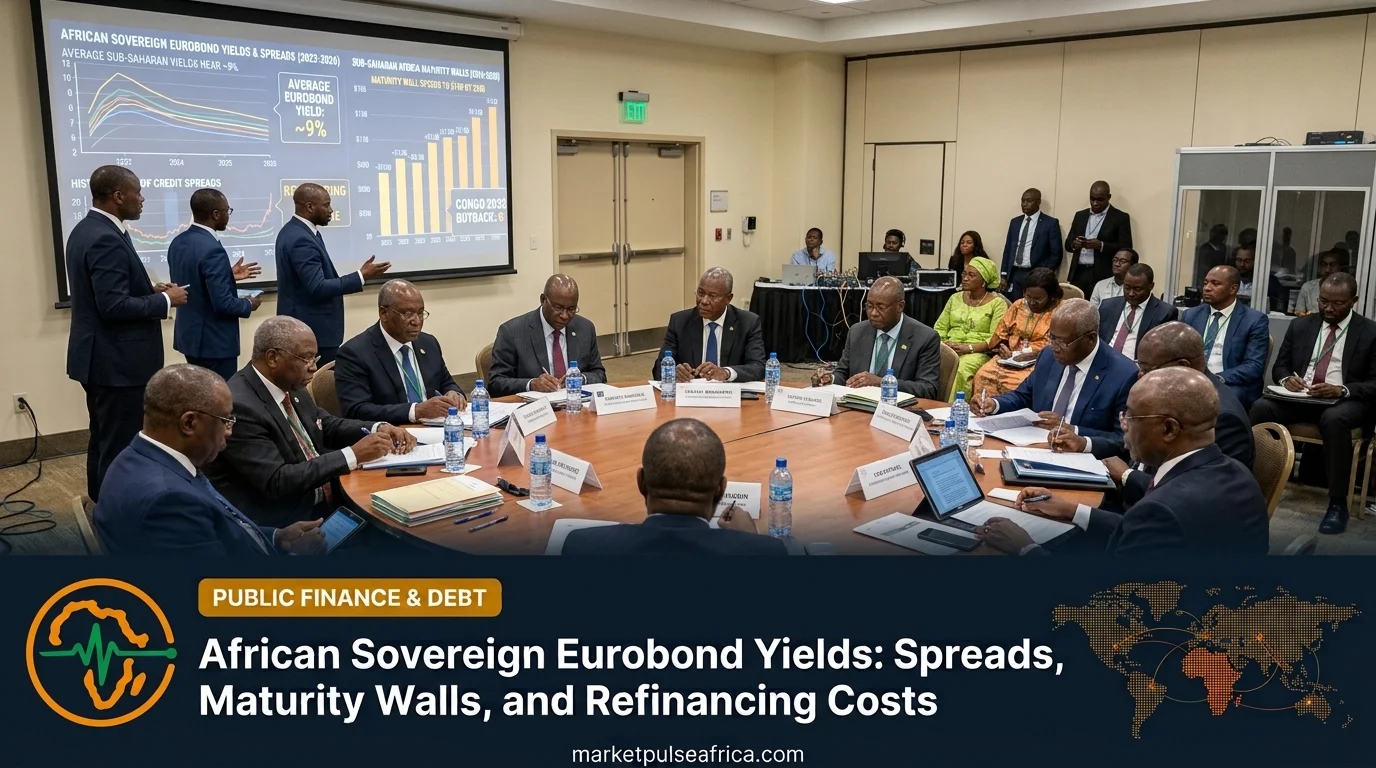
Sub-Saharan African governments borrowed more in the international bond market in the first two months of 2026 than in any start to a year since 2013. The harder part comes in 2028, when repayments peak.
Five sub-Saharan governments raised about US$5.9 billion in Eurobonds in January and February 2026 against US$1.8 billion a year earlier, Eurobond spreads were tighter at the end of June 2026 than at the start of 2025, and the World Bank puts sub-Saharan repayments at about US$3.5 billion in 2026, rising to a peak of US$8.6 billion in 2028. Access has reopened, but later deals have been fewer and more expensive.
This brief covers the 2026 issuance, what spreads and yields show, the maturity profile by country, and how issuers are managing the wall.
- The 2026 reopening
- Spreads and yields
- The maturity wall
- Managing the wall
- Cheaper routes and their limits
- What to watch
- Related Reading
The 2026 reopening
IFR reported that five sub-Saharan African governments raised around US$5.9 billion in the first two months of 2026, the strongest start since 2013, after a market that was largely closed between 2022 and early 2024. The sequence of deals it lists:
- 22 January: Benin, US$850 million sukuk and Eurobond package
- 25 March: Angola, US$2.5 billion
- 9 April: Democratic Republic of Congo, debut US$1.25 billion Eurobond
- May: Angola, a further US$1.5 billion
- 30 July: Gabon, US$920 million private placement
Kenya led the early rush with a US$2.25 billion dual-tranche deal, the largest African bond sale of 2026 at that point. The same report said Côte d'Ivoire, the Republic of Congo, Cameroon and Benin also tapped international markets in recent weeks.
Takeaway: the market opened wide in the first quarter and narrowed after, with IFR noting that subsequent deals were fewer and more expensive.
Spreads and yields
Spreads have improved over a longer period. The IMF reported in November 2025 that Africa's average spread over US Treasuries was about 3.7 percentage points, the lowest since 2018, though still above other emerging regions. Nigeria's exchange-rate unification and Kenya's fiscal adjustments helped lower their issuance costs.
The OECD's 2026 Africa Capital Markets Report found that spreads on Eurobonds were tighter by the end of the second quarter of 2026 than at the start of 2025, despite multiple exogenous shocks. It adds that spreads had risen fairly consistently from early 2020 to the end of 2024, and that refinancing risks increased during 2025 and the first half of 2026.
Yields themselves are a different story. IFR expects higher US interest rates to narrow the window further. The US rate is the base of every African yield, so a stable spread still means a higher cost to the issuer when it rises.
The maturity wall
The World Bank's October 2026 Africa Economic Update, as reported by MyJoyOnline, estimates that sub-Saharan sovereign Eurobond principal maturing between 2024 and 2030 amounts to about US$43.6 billion across 13 countries, after adjusting for buybacks and liability management operations.
Country burdens named in the report
- Ghana: US$6.4 billion between 2027 and 2030
- Nigeria: US$6.4 billion
- Angola: US$3.9 billion
The excerpt we reviewed lists these three as following a larger burden for another country that it does not name, so the list is not complete. The profile also differs by source. IFR cites the World Bank for repayments rising from about US$3.5 billion in 2026 to a peak of US$8.6 billion in 2028. The October update says liability management by Angola, Kenya and Côte d'Ivoire has reduced the 2028 concentration to about US$5.5 billion. The two figures use different adjustments, so quote the one that matches the basis you need.
Managing the wall
Issuers are using new money to retire older debt. Kenya and Congo deployed part of their proceeds to buy back more expensive bonds, smoothing maturities and cutting interest costs. Kenya also rolled over its US$2 billion Eurobond due in 2024 through a US$1.5 billion issue at a yield of 10.4%, supplemented by budget resources, which extended the maturity but raised future debt service relative to the original bond.
Ghana and Zambia show the other route. Both restructured, and our report on the Common Framework process compares the timelines.
Cheaper routes and their limits
An analysis by Rafiq Raji says Senegal argued it used total return swaps to obtain external debt at about 7%, almost half the 11% to 12% yields on its Eurobonds. Eurobond creditors object to such derivatives and may require domestic debt to be included in any future restructuring.
The same paper reports that rates on Chinese loans, once cheaper than bonds, more than doubled to 5.7% from 2.5%, which probably reflects a changed perception of African debt risk as well as the effects of the Iran war. The author expects at least two more African sovereigns, potentially Senegal and Mozambique, to rework their external debt before the end of 2026.
What to watch
- The US Treasury yield. It sets the floor for every African new issue.
- 2028 refinancing plans. Issuers with large 2028 maturities are likely to pre-fund or buy back early.
- Restructuring contagion. Senegal's treatment of its derivatives and domestic debt will set terms for others.
- Cameroon's market access. Cameroon tapped the market in 2026, and its CEMAC peers depend on BEAC reserves, as we explain in our report on the XAF/XOF parity mechanism.
Related Reading
- Read our full coverage of the Common Framework and African debt restructuring
- Read our full coverage of the XAF/XOF parity mechanism and reserve structure
- Read our full coverage of the Angolan kwanza and oil revenue backing
Which African issuer faces the hardest refinancing in 2028? Keep following Market Pulse Africa for the next Eurobond issuance and World Bank debt update.


